







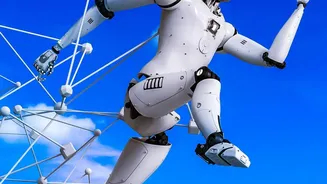
What Exactly Is Agentic AI?
At its core, agentic AI refers to artificial intelligence systems that can operate autonomously to achieve a goal with minimal human supervision. Unlike the AI we commonly interact with now, which is reactive and needs specific prompts to perform a task,
agentic AI is proactive. It can perceive its environment, make decisions, create a multi-step plan, and then execute that plan. Think of it less like a chatbot and more like an autonomous employee. You give it a high-level objective, like 'organise a marketing campaign for our new product launch,' and it can then break that down into smaller tasks, interact with different software systems, and carry them out.
Beyond a Smarter Chatbot
The key difference between today's generative AI tools and agentic AI is the shift from reaction to autonomy. A generative AI like ChatGPT is excellent at creating content based on your prompts, but it stops there. An agentic system takes that a step further. It can use generative AI to draft marketing copy as one step in a much larger, self-orchestrated workflow. These systems can be made up of multiple, specialised AI 'agents' that collaborate, with each one handling a specific part of a complex task, like one agent for research, one for scheduling, and another for drafting communications. This creates a system that doesn’t just answer questions, but actively participates in and advances workflows.
The New AI Teammate in Action
Imagine an AI teammate that handles the tedious coordination that bogs down projects. It could manage a new employee's onboarding process, ensuring they get the right access to different systems and that all paperwork is completed across HR, IT, and their new department. In a project management context, an agent could monitor progress, flag potential delays before they become critical, and even automatically generate and distribute status updates to relevant stakeholders, reducing the need for constant check-in meetings. For a sales team, an AI agent could sift through customer data to prioritise the best leads, draft personalised outreach emails, and update the CRM system, freeing up the sales professionals to focus on building relationships.
Redefining Human Roles and Skills
The rise of agentic AI doesn't necessarily signal a future without human workers, but rather a rebalancing of roles. The focus of human work is expected to shift from task execution to strategy, creative problem-solving, and oversight. As AI agents take on more of the repetitive, process-driven work, human team members will be freed up to concentrate on the aspects that require nuance, empathy, and high-level judgment. This will place a premium on skills like collaboration, strategic planning, and what some are calling 'AI fluency'—the ability to effectively manage, guide, and work alongside these new AI teammates. The future of work is envisioned as a seamless hybrid model where humans and AI agents collaborate, each playing to their strengths.
Navigating the Hurdles and Risks
Despite its immense potential, the path to integrating agentic AI is not without its challenges. The very autonomy that makes these systems powerful also introduces risks. There are significant concerns around security, as a compromised autonomous agent could be exploited for cyberattacks or fraud. Furthermore, there is the issue of control and predictability; ensuring an AI agent's actions always align with business goals requires robust guardrails and oversight. Trust is another major barrier, with some studies showing declining trust in fully autonomous systems. Successful implementation will require more than just new technology; it will demand a cultural shift within organisations, a redesign of workflows, and a significant focus on upskilling employees to work in these new human-AI teams.