




First, Check Your Calendar
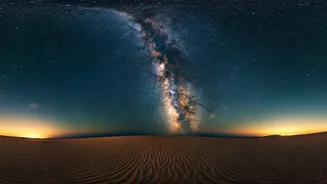
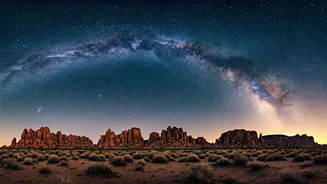
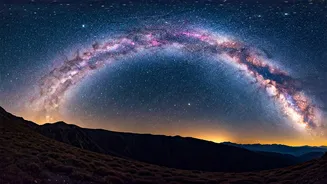
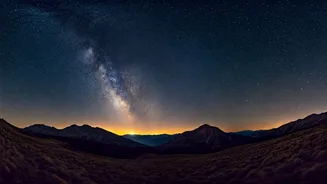
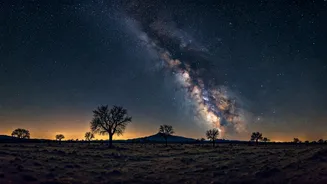
The Milky Way’s bright galactic core isn’t visible all year round. For us in India, the prime viewing season runs from March to October. During these months, the core rises in the southeastern sky and arcs overhead through the night. But the single most
important factor for your weekend plan is the Moon. A bright, full moon acts like a giant spotlight, washing out the faint light of the galaxy. The best time for stargazing is during the New Moon phase, or the week before and after it, when the sky is at its darkest. Check a lunar calendar online for this weekend. The ideal time to look is usually after midnight, once the sky is truly dark and the core has risen high enough to be seen clearly.
Escape the City Lights
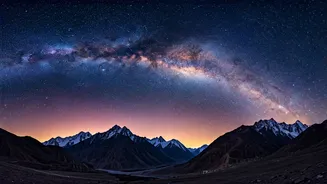
To see the galaxy’s core, you need one thing above all else: dark skies. City light pollution is the number one enemy of stargazing. You need to get as far away from urban centres as possible. Websites like Light Pollution Map can help you find 'dark sky' locations near you. In India, some of the most famous spots for pristine skies include Ladakh and Spiti Valley in the north. However, you don’t need to book a flight. Many accessible locations work just as well. Think of remote areas in the Western Ghats, the salt flats of the Rann of Kutch, national parks away from towns, or even just a rural village an hour or two outside your city. The key is to find a spot with a clear, unobstructed view of the southern horizon.
Gear Up: From Smartphone to DSLR
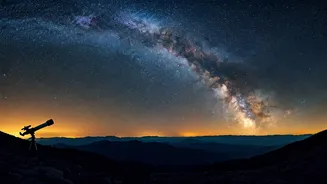
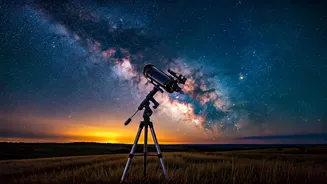
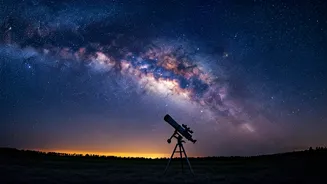
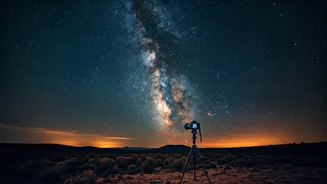
You don't need a telescope to see or photograph the Milky Way. Your own eyes are enough to spot it in a dark location. To 'map' and capture it, here’s what you’ll need: **The Basics:** * **A Smartphone:** Many modern phones (like recent iPhones, Google Pixels, and Samsung flagships) have excellent 'Night Mode' or 'Astrophotography' settings that can capture the Milky Way. * **A Tripod:** This is non-negotiable. To capture faint light, your camera needs to be perfectly still for a long exposure (several seconds). A small, portable tripod for your phone or camera is essential. **For Better Shots:** * **A DSLR or Mirrorless Camera:** These give you manual control for far superior results. * **A Wide-Angle Lens:** A lens with a wide aperture (like f/2.8 or lower) is ideal as it lets in more light.
Use an App to Find the Core
The galactic core isn’t just 'up there'—it's in a specific location that changes throughout the night. Don't just guess. Use a stargazing app to pinpoint it. Apps like Stellarium, SkyView Lite, or Star Walk 2 use your phone's GPS and compass to show you exactly what's in the sky. Simply open the app, point your phone towards the sky, and it will overlay the names of stars, constellations, and the Milky Way itself. Look for the densest, brightest part of the Milky Way band—that’s the core. It’s located in the direction of the Sagittarius constellation, which the app will help you find easily.
How to Capture the Glow
Once you've found a dark spot and located the core, it's time to take the shot. Mount your camera or phone on the tripod and point it towards the galactic core. **For Smartphone Users:** Enable your phone’s 'Night Mode' or 'Pro Mode'. If you have manual controls, try setting the shutter speed to 10-30 seconds and ISO to between 1600 and 3200. Use the self-timer (2-3 seconds) to avoid shaking the phone when you tap the shutter button. **For DSLR/Mirrorless Users:** * **Switch to Manual Mode (M).** * **Aperture:** Set it to the widest possible opening (the lowest f-number, e.g., f/1.8, f/2.8). * **Shutter Speed:** Start with 15-20 seconds. If your stars look like streaks, reduce the time. If the image is too dark, increase it slightly. * **ISO:** Start at 1600 and adjust up to 3200 or 6400 depending on how dark your location is. * **Focus:** Switch to manual focus. Point at a bright star, zoom in using your camera’s screen, and adjust the focus ring until the star is a tiny, sharp point of light. Take a test shot, review it, and adjust your settings. The first time you see the glowing core appear on your screen is a moment of pure magic.