




A New Window on the Universe
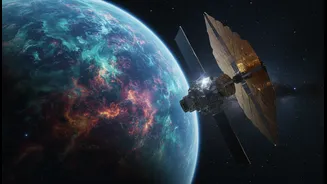
Since beginning its mission, the James Webb Space Telescope (JWST) has been peeling back the cosmic curtains, allowing humanity to witness the universe with unprecedented clarity. Its ability to capture infrared light, which is invisible to the human eye,
allows it to see through clouds of dust and gas that obscure the view of other telescopes. This capability is particularly powerful when studying the bookends of a star's life: its birth in a dusty nebula and its dramatic, often beautiful, demise. These final chapters of a star's existence, once relegated to textbook diagrams and blurry images, are now being rendered in such exquisite detail that they feel almost tangible, bridging the vast emptiness of space and connecting us to the cosmic cycles of life and death.
A Glimpse of Our Sun's Future
One of the most captivating images from Webb is its portrait of the Ring Nebula, located about 2,500 light-years away. This object is a classic planetary nebula, which forms when a star like our own Sun runs out of fuel and sheds its outer layers. Past images showed a colorful, doughnut-shaped cloud, but Webb's view reveals so much more. We can now see the intricate, filament-like structure of the inner ring and roughly 20,000 dense globules of molecular hydrogen. Even more fascinating are the faint concentric arcs in the outer regions, which suggest the dying star had an unseen companion, its gravitational pull shaping the nebula like a celestial potter. Astronomers describe studying these features as a form of astronomical archaeology, allowing them to learn about the star that created it. For us, it’s a preview of our own Sun's distant fate, an ending that now looks less like a quiet fade and more like a complex, structured farewell.
The Aftermath of a Violent Explosion
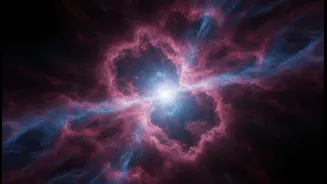
Not all stars die so gently. Massive stars end their lives in cataclysmic supernova explosions, and Webb has given us a front-row seat to the aftermath. Its images of Cassiopeia A (Cas A), the remnant of a supernova whose light first reached Earth about 340 years ago, are nothing short of breathtaking. Located 11,000 light-years away, Cas A is a chaotic debris field of an exploded star. Webb’s mid-infrared vision reveals stunning details within the expanding shell of material, showing where it is slamming into surrounding gas and dust. These explosions are fundamental to our own existence; they forge and scatter heavy elements like the iron in our blood and the calcium in our bones across the galaxy. As one scientist put it, by studying the process of exploding stars, we are reading our own origin story. Webb’s detailed view of Cas A helps astronomers understand how these essential building blocks of life are distributed, connecting a violent cosmic death to the very possibility of life on Earth.
Life After Stellar Death
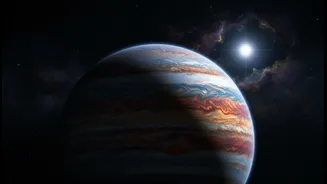
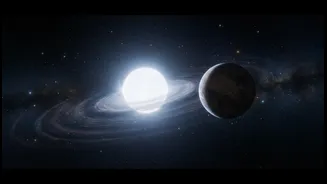
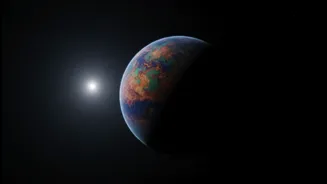
Perhaps most profoundly, Webb has shown that a star's death is not necessarily the end for its entire planetary system. In a landmark observation from July 2026, the telescope studied a Jupiter-sized planet, WD 1856 b, orbiting a white dwarf — the dense, dead core of a once Sun-like star. The star died billions of years ago, and any planet orbiting as closely as WD 1856 b does now should have been destroyed when the star swelled into a red giant. By analyzing the planet's atmosphere for the first time, Webb found it was surprisingly warm and contained methane. This suggests the planet migrated inward long after the star died. This discovery is like using a time machine to look into our own solar system's distant future, showing that outer planets like Jupiter might survive our Sun's demise and reshuffle their orbits. It proves that some planets can have a vibrant future, even after their star has died.