





The Famous Northern Hexagon
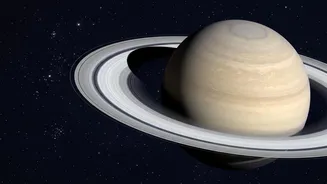
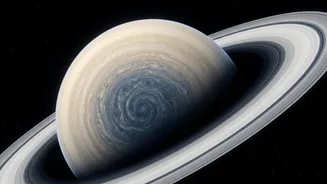
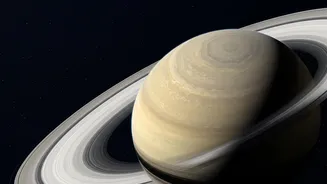
Ever since NASA's Voyager spacecraft flew by Saturn in the early 1980s, scientists have been fascinated by a bizarre feature at its north pole. A colossal, six-sided jet stream, known simply as 'the hexagon', churns relentlessly in the clouds. This atmospheric
pattern is enormous, stretching about 30,000 kilometers across, and has remained remarkably stable for over four decades of observation. It behaves like a persistent wave in the atmosphere, with winds whipping around its geometric perimeter. For years, this hexagon was considered a unique marvel, a one-of-a-kind structure with no equivalent elsewhere on the planet or in the solar system. Scientists theorized about the fluid dynamics that could create such a stable, straight-edged storm on a gaseous world, but they always had only one example to study.
A New Shape Appears in the South
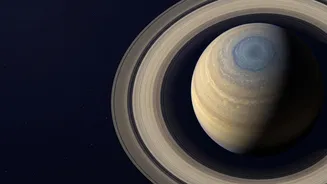
Now, that has all changed. Recent images from the Hubble Space Telescope have confirmed the existence of a new, massive polygon at Saturn's south pole. But this isn't a twin to the northern storm; it's a decagon, a 10-sided atmospheric wave. This stunning discovery came as a surprise. The Cassini spacecraft, which orbited Saturn from 2004 to 2017, saw no evidence of such a long-lived structure at the south pole. It wasn't until the planet's southern hemisphere tilted back towards Earth in recent years, coming into view for Hubble and ground-based observatories, that hints of the new shape began to emerge. Archival data suggests the feature started forming around 2023 and has been strengthening ever since.
The Decagon Puzzle
The discovery of the decagon presents a fascinating new puzzle for planetary scientists. The primary question is why this feature formed so suddenly and recently, while the northern hexagon has been a permanent fixture for as long as we've been able to see it. The new southern storm appears different in other ways, too. It seems to be less stable than its northern counterpart and migrates slowly eastward, unlike the nearly stationary hexagon. Furthermore, the decagon is a deep, vertically extended structure, meaning it's not just a surface-level cloud pattern but a wave that persists through multiple layers of Saturn's atmosphere. This depth is similar to the hexagon, suggesting they may be formed by related physical processes deep within the gas giant. The mystery is why one pole would produce a stable hexagon while the other suddenly spawns a less stable decagon.
What It Means for Planetary Science
This discovery does more than just add another curiosity to Saturn's portfolio. It provides a rare opportunity for scientists to watch a giant atmospheric pattern develop in real-time, offering invaluable data for understanding planetary weather. By comparing the brand-new decagon with the long-lived hexagon, researchers can refine their models of how such geometric storms are born and what makes them stable. Are they related to the planet's powerful jet streams, seasonal changes in solar radiation, or something happening deep within Saturn's interior? Answering these questions about Saturn helps us understand the atmospheres of other gas giants, including Jupiter with its own distinct polar cyclones, and even the thousands of exoplanets discovered orbiting distant stars. The fact that Saturn can produce two different polygons suggests the underlying physics are more complex than previously believed.