



A New Window on Cosmic Dawn
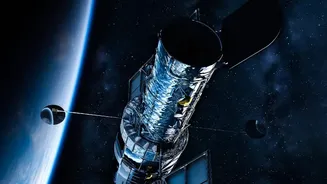
When we look at distant objects in space, we are looking back in time because of the immense time it takes for their light to reach us. The James Webb Space Telescope was specifically engineered to capture infrared light, which is crucial for studying
the early universe. As the universe expands, the light from the most ancient galaxies gets stretched from visible and ultraviolet into infrared wavelengths. This allows Webb to see past the limitations of its predecessor, the Hubble Space Telescope, and detect galaxies that existed just a few hundred million years after the Big Bang. These observations are part of a period astronomers call "Cosmic Dawn," when the first stars and galaxies began to clear the opaque fog of neutral hydrogen that once filled the cosmos.
The Unexpected Maturity of Early Galaxies
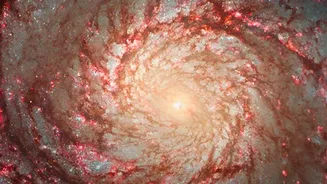
For decades, the prevailing theory was that the first galaxies were chaotic, clumpy, and disorganized messes. Scientists believed that complex, ordered structures like the spiral arms and central bars seen in modern galaxies, including our own Milky Way, took billions of years to form. A galactic bar is a dense, linear structure of stars and gas that slices through a galaxy's core. These bars are considered a sign of a mature, evolved galaxy. They act like cosmic highways, funneling gas toward the galactic center, which can fuel bursts of star formation and feed the growth of supermassive black holes. The assumption was that such orderly structures simply couldn't exist in the turbulent early universe.
Webb's Game-Changing Discovery
This long-held assumption is being overturned by Webb's powerful gaze. Astronomers using data from large surveys like the Cosmic Evolution Early Release Science (CEERS) program have spotted barred spiral galaxies that existed much earlier than thought possible. One remarkable example, named COSMOS-74706, was found to have a distinct stellar bar when the universe was only about two billion years old—a cosmic teenager, in relative terms. Another galaxy, CEERS-2112, which looks strikingly like a younger version of our Milky Way, was observed as it was more than 11.7 billion years ago. Finding these well-organized structures so early in cosmic history is forcing a major rethink of galactic evolution.
Rewriting the Galactic Playbook
The discovery of ancient barred galaxies has profound implications. It suggests that the processes that shape galaxies into orderly spirals can happen much faster than models predicted. If galaxies can form stable, mature structures like bars so quickly, it means the early universe was capable of producing galaxies that were not just chaotic blobs but dynamically organized systems. This forces astronomers to adjust their timelines for how soon galaxies like the Milky Way could have become structured. The presence of these bars helps explain other Webb findings, such as surprisingly massive black holes in the early cosmos, as the bars provide an efficient mechanism for feeding them. Essentially, Webb is showing that the universe may have started building grand, beautiful galaxies far sooner than we ever imagined.