
A New Class of Worlds
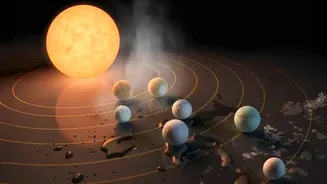
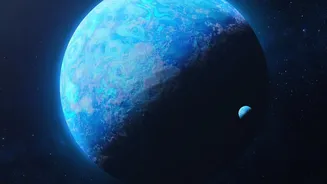
Before we dive into the 'how', let's talk about the 'what'. The term 'Super-Earth' describes a type of planet we don't have in our own solar system. These are worlds with a mass higher than Earth's but substantially lower than that of our ice giants,
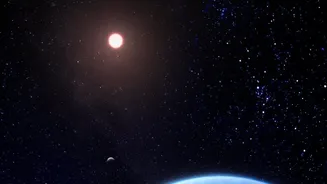
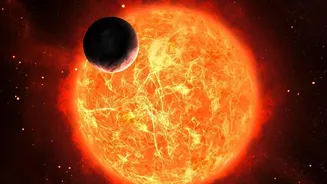
Uranus and Neptune. They can be rocky, ocean-covered, or shrouded in a thick gas envelope. Thousands have been discovered, but they remain mysterious because, until now, we've struggled to see what their atmospheres are made of. Planets like K2-18 b and GJ 1214 b, both examples of this class, have been prime targets for JWST's powerful gaze. K2-18b, for example, is about 8.6 times the mass of Earth and has tantalised scientists since Hubble first detected hints of water there.
The Telescope's Chemical Sniffer
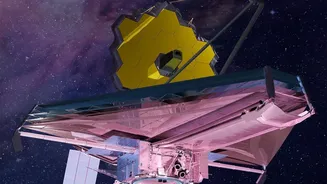
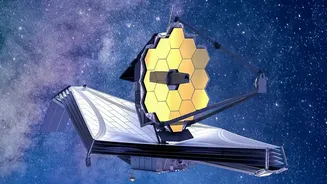
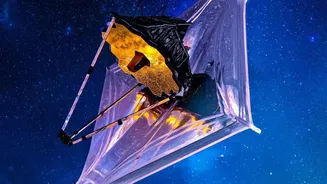
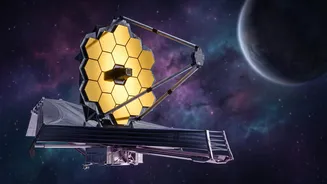
So how does a telescope 1.5 million kilometres away sniff out water on a planet light-years from home? The technique is called transmission spectroscopy. When a planet passes in front of its star from our point of view, a tiny fraction of the starlight filters through the planet's atmosphere. Different molecules in that atmosphere absorb light at specific, known wavelengths. Water, methane, carbon dioxide—they all have unique spectral 'fingerprints'. JWST's incredibly sensitive infrared instruments can detect which wavelengths of light are missing from the starlight after it has passed through the atmosphere. By analysing this pattern of absorbed light, astronomers can build a chemical profile of the distant world's air.
Unveiling Water Worlds
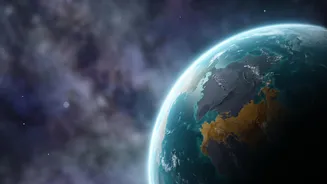
Recent observations have put this technology to the test. For K2-18 b, which orbits within its star's habitable zone, JWST has confirmed the presence of not just water vapour but also carbon-bearing molecules like methane and carbon dioxide. This combination has strengthened the hypothesis that K2-18 b could be a 'Hycean' world—a planet with a water ocean beneath a hydrogen-rich atmosphere. Similarly, for GJ 1214 b, a 'mini-Neptune' that had long been obscured by a thick layer of haze, JWST's infrared eyes have finally pierced the veil, revealing compelling evidence of a water-rich atmosphere. While this world is too hot for liquid oceans, it may have once been a 'water world' before migrating closer to its star.
Is Anyone Home?
Finding water vapour is a monumental step, but it is crucial to manage expectations. The presence of water vapour does not automatically mean a planet is habitable. The temperature has to be just right for liquid water to exist on the surface—a key ingredient for life as we know it. For many of these planets, like the scorching GJ 1214 b, the surface is far too hot. For others, like K2-18 b, the conditions are more promising, but the term 'habitable' remains a scientific possibility, not a confirmation. These discoveries are less about finding life today and more about understanding the diversity of planetary environments and identifying the most promising candidates for future, even more detailed, investigation.
A New Era of Exploration
Every spectral signature captured by the JWST marks a new milestone in our cosmic journey. We've graduated from simply discovering exoplanets to being able to characterise them in detail. These findings, from worlds like K2-18 b and GJ 1214 b, are not just isolated discoveries; they are foundational pieces in a much larger puzzle about planetary formation and evolution. For scientists in India and around the world, this data provides invaluable ground truth for refining models of how planets form and what makes a world potentially habitable. As JWST continues its mission, it will undoubtedly uncover more worlds with even more intriguing atmospheric compositions, taking us ever closer to answering that age-old question: Are we alone?