


A New Eye on the Cosmos
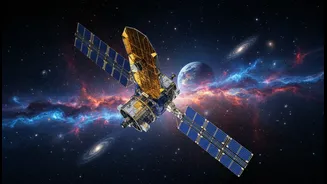
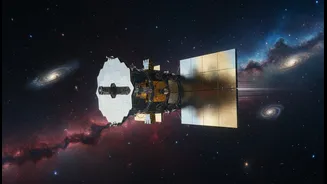
Scheduled for launch on August 30, 2026, NASA's Nancy Grace Roman Space Telescope is a next-generation observatory poised to revolutionize our understanding of the universe. Named after NASA's first chief of astronomy, Nancy Grace Roman, this powerful
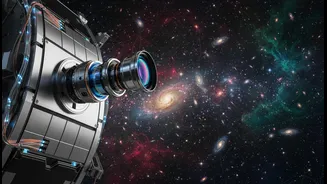
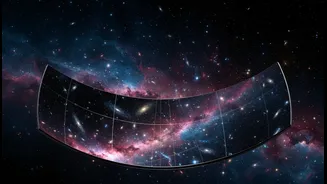
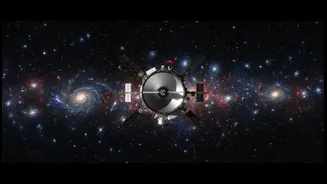
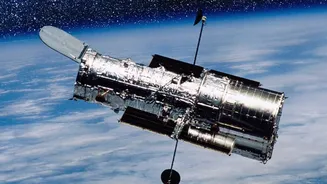
telescope has a primary mirror the same size as Hubble's but with a field of view over 100 times larger. This incredible panoramic capability will allow it to map vast regions of the sky with unprecedented speed and detail. While the James Webb Space Telescope zooms in for deep, narrow looks at cosmic wonders, Roman will provide the wide-angle context, creating enormous cosmic maps that could take Hubble a century to produce. Its five-year primary mission will be to tackle some of the most profound questions in astrophysics: the nature of dark energy, the properties of dark matter, and the evolution of the universe itself.
Hunting the Universe's Invisible Majority
The ordinary matter that makes up stars, planets, and us accounts for only about 5% of the cosmos. The rest is a combination of dark matter and dark energy. Dark matter is an invisible substance that doesn't emit or reflect light, but its gravitational pull is what holds galaxies together. Dark energy is an even more enigmatic force that is causing the expansion of the universe to accelerate. Roman is specifically designed to probe these two mysteries. It will do so by observing how the distribution of galaxies has changed over billions of years. One of its key methods is called weak gravitational lensing, where it will measure the subtle ways that the gravity from massive clumps of dark matter bends the light from distant galaxies. By mapping these distortions across the sky, scientists can create a detailed 3D map of the universe's invisible dark matter structure.
A Cosmic Time Machine
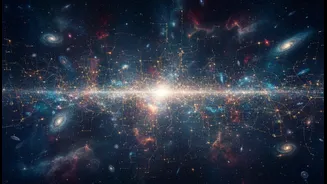
Telescopes are a form of time machine. Because light takes time to travel across cosmic distances, looking at faraway galaxies means we are seeing them as they were billions of years ago. Roman will use this principle to study cosmic evolution. By creating the largest-ever 3D maps of the universe, it will trace how galaxies and large-scale cosmic structures grew and changed over time. This will provide crucial tests for our theories of cosmology. The telescope will also hunt for thousands of Type Ia supernovae—exploding stars that serve as 'standard candles' for measuring cosmic distances. By precisely measuring their brightness and distance, Roman will chart the expansion history of the universe, providing new insights into the behavior of dark energy and whether it has changed over cosmic time.
Beyond the Big Mysteries
While dark energy and dark matter are its headline acts, Roman's scientific reach is far broader. The same wide, deep surveys that map the cosmos will also be a treasure trove for other areas of astronomy. The mission is expected to discover thousands of exoplanets using a technique called gravitational microlensing, which can find planets much farther from their stars than other methods. This will give us a much more complete census of planets across our galaxy, from rocky worlds to gas giants. In addition, Roman will be able to spot distant, ancient black holes by observing the flare-ups that occur when they tear stars apart. This will help scientists understand how the supermassive black holes found at the centers of galaxies formed and grew so large in the early universe. From mapping our own Milky Way to studying the life cycles of stars, Roman's data will fuel astronomical discovery for decades.