





A Sweet Discovery, Light-Years Away
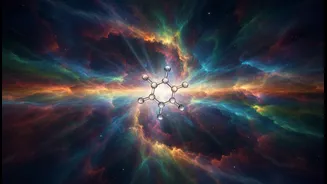
An international team of astronomers has detected a four-carbon sugar called erythrulose in a giant molecular cloud near the center of our Milky Way galaxy. The cloud, known as G+0.693−0.027, is a vast, cold nursery for new stars, located about 26,700
light-years from Earth. While simpler organic molecules are commonly found in space, and sugars have been discovered in meteorites that have landed on Earth, this marks the first time a true sugar of this complexity has been directly identified in the interstellar medium. Using highly sensitive radio telescopes in Spain, researchers, led by Izaskun Jiménez-Serra, were able to match the faint radio signals emanating from the cloud with the unique chemical signature of erythrulose.
The Cosmic Recipe for Life
So, why does finding sugar in a distant gas cloud matter? Sugars are fundamental to life as we know it. They are not just a source of energy; they form the structural backbone of RNA and DNA, the molecules that carry our genetic code. The search for these “prebiotic” molecules in space is central to understanding abiogenesis—the process by which life arises from non-living matter. The theory is that if these crucial building blocks can form in space, they could be delivered to young, rocky planets by comets and asteroids. This cosmic seeding could provide the raw materials needed to kickstart life. The discovery of erythrulose is particularly exciting because, in the presence of liquid water, it can be converted into other sugars that are considered potential precursors to the ribose used in RNA.
Challenging Old Theories
Perhaps the most significant part of this discovery is not just what was found, but how much of it there is. The science team found that erythrulose is at least eight times more abundant than simpler, three-carbon sugars in the same cloud. This finding throws a wrench into the prevailing theory of how complex molecules form in space. For a long time, scientists have believed in a stepwise process, where molecules are built up one carbon atom at a time. The high concentration of a four-carbon sugar suggests a different pathway might be at play. The researchers propose that erythrulose may have formed from the combination of two-carbon molecules on the icy surfaces of dust grains. This opens up new possibilities for how the complex chemistry needed for life can get started in the cold, harsh environment between stars.
Listening to the Stars
Detecting a specific molecule from trillions of kilometres away is a remarkable feat of science. Astronomers can’t simply scoop up a sample of a gas cloud. Instead, they use powerful radio telescopes to listen for the faint frequencies emitted by molecules as they rotate and vibrate in space. Each molecule has a unique spectral “fingerprint.” In this case, the team used the Yebes 40-meter and IRAM 30-meter telescopes to conduct a deep survey of the molecular cloud. They painstakingly sifted through the noise to find 12 distinct spectral lines that perfectly matched the laboratory signature of erythrulose, confirming its presence with a high degree of confidence.
A Clue, Not a Conclusion
It’s important to put this discovery into perspective. Finding sugar in space does not mean we have found alien life. Rather, it means that a key ingredient in the recipe for life is present in the raw materials from which new solar systems are born. Previous discoveries have found other crucial components, such as amino acids and nucleobases, on meteorites. This detection of a complex sugar directly in an interstellar cloud strengthens the case that the universe is a vast chemical laboratory, capable of producing the molecules necessary for biology. It suggests that the building blocks for life may not be rare at all, but a common feature of star and planet formation across the galaxy.