




The Moon's Hostile Surface
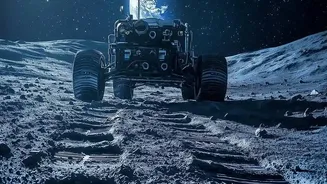
Establishing a permanent human presence on the Moon isn't as simple as just landing and building. The lunar surface is one of the most hostile environments imaginable. Lacking Earth's protective atmosphere and magnetic field, it's constantly blasted with
galactic cosmic radiation and solar energetic particles. This radiation can damage human DNA and significantly increase cancer risk, making long-duration stays on the surface incredibly dangerous. Furthermore, temperatures swing wildly from a scorching 127 degrees Celsius in the day to a frigid -173 Celsius at night. There is also the persistent threat of micrometeorites, tiny particles traveling at immense speeds that can puncture spacesuits and structures. Any surface habitat would require extensive, heavy shielding, which is prohibitively expensive to launch from Earth.
Nature’s Underground Shelter
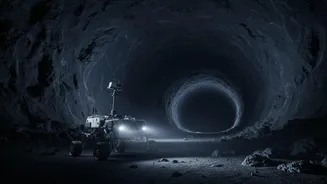
The solution might not be in what we can build, but in what nature has already provided. Scientists are increasingly confident that the Moon is riddled with vast, underground tunnels known as lava tubes. These were formed billions of years ago when the top layer of flowing molten rock cooled and solidified, while the lava inside continued to flow, eventually draining away to leave a hollow cave. Some of these tubes are thought to be colossal, potentially a kilometer or more wide and hundreds of kilometers long—large enough to house entire towns. Their thick rock ceilings, estimated to be tens of meters deep, offer a natural and highly effective shield against radiation, micrometeorites, and extreme temperature fluctuations. Inside a lava tube, temperatures are believed to hold at a stable, albeit cold, -20 to -25 degrees Celsius, making it a much more manageable environment for habitation.
Meet the Robotic Cave Explorers
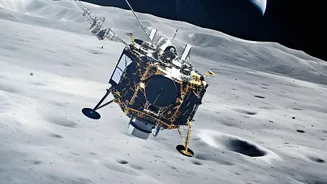
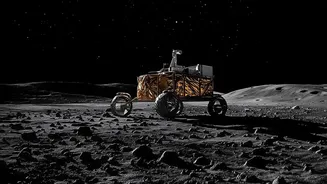
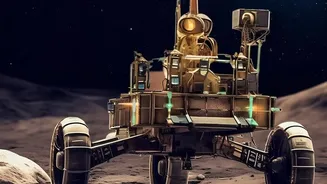
Before humans can move in, we need to know what's down there. This is where advanced robotics comes in. Because these caves are dark, unmapped, and difficult to access, they are perfect candidates for autonomous robotic exploration. Several space agencies and private companies are developing innovative concepts. One European consortium has tested a trio of collaborating robots: one to map the entrance, another to lower a scout rover into the pit, and the scout itself to explore and create a 3D map of the interior. NASA is funding research into a laser-powered, tethered drone called the Lunar Underground eXplorer (LUX). This drone would be lowered into a pit and receive power and transmit data through a fiber optic cable, allowing it to navigate the total darkness without a heavy battery. China is also exploring the use of four-legged "robot dogs" designed to better navigate the uneven, rubble-strewn floors of these caves.
The Challenge of Going Underground
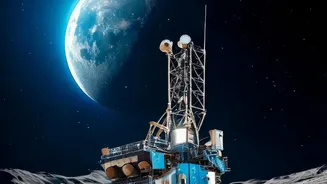
Exploring a lunar cave is a monumental engineering challenge. The robots must be highly autonomous, able to make decisions and navigate a completely unknown 3D environment without GPS. Total darkness means rovers cannot rely on solar power, requiring alternative energy sources like tethers or radioisotope power systems. Communication is another major hurdle; transmitting data from deep within a cave to a surface lander, and then back to Earth, is incredibly complex due to the rock blocking signals. This necessitates either a communications tether or a network of relay devices. The terrain itself is a huge unknown. Entrances, known as skylights, can be deep vertical pits, requiring rovers to be rappelled down on a crane or tether. The cave floor could be smooth or filled with sharp rocks and collapsed debris, demanding robust and versatile mobility systems.
From Robotic Probe to Lunar Base
These robotic missions are the critical first step toward a revolutionary shift in space colonization. Once a suitable lava tube is identified and mapped, the path to a permanent base becomes much clearer. The vision is to land inflatable or modular habitats that can be deployed inside the cave. Protected by the natural rock ceiling, these structures would not need the heavy shielding required on the surface, dramatically reducing the cost and complexity of establishing a settlement. Inside these vast caverns, astronauts would be safe from radiation and meteorite strikes, living in a stable thermal environment. These bases could serve not just as habitats but as vast scientific laboratories, enabling long-term research into lunar geology and the search for resources like water ice, which may be trapped in these cold, dark spaces.