


The Eiger North Face, Switzerland
Known by its chilling German nickname, 'Mordwand' (Murder Wall), the North Face of the Eiger is one of the most legendary and treacherous climbs in the Alps. It’s not the height that gets you—at 3,967 metres, it’s shorter than many Himalayan peaks—but
the combination of technical difficulty and lethal unpredictability. The 1,800-metre face is a vertical maze of brittle rock, cascading ice fields, and notoriously bad weather that can roll in without warning, turning the route into a deathtrap of falling rock and avalanches. Climbers must be masters of both rock and ice climbing, moving quickly and efficiently while constantly exposed. The route's dark history, littered with tragedies from early attempts, serves as a constant reminder that the Eiger demands absolute respect and a deep well of experience.
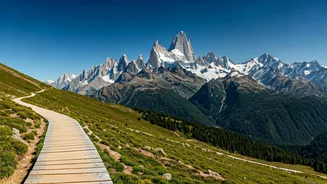
Cerro Torre, Patagonia
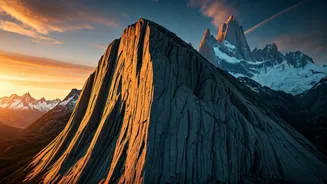
Imagine a dagger of granite stabbing the sky, its peak guarded by colossal, unstable mushrooms of rime ice. That is Cerro Torre. Located in the Southern Patagonian Ice Field, this spire is notorious for having some of the worst weather on the planet. Hurricane-force winds, born over the vast expanse of ice, scour the mountain, making any ascent a gamble. The technical challenge is immense, requiring elite-level rock climbing on sheer, often ice-plastered granite. But the final, and most infamous, obstacle is the summit mushroom. This overhanging blob of frozen moisture is not solid ice; it’s weakly bonded rime that can collapse at any moment. To stand on the true summit of Cerro Torre is to have conquered not just a mountain, but a meteorological monster.
Annapurna I, Nepal
In the world of high-altitude mountaineering, some peaks are known for their beauty, others for their challenge, and a few for their sheer lethality. Annapurna I falls firmly into the last category. As the 10th highest peak in the world, its main threat isn't technical difficulty in the same way as a sheer rock face, but objective danger on an almost unimaginable scale. The mountain is massively prone to avalanches, with huge, unstable seracs (ice cliffs) looming over the main climbing routes. For every three climbers who have successfully reached its summit, one has died trying, giving it the most terrifying fatality-to-summit ratio of any 8,000-metre peak. Surviving Annapurna requires not just incredible physical endurance to cope with the 'death zone' above 8,000 metres, but an enormous amount of luck.
The Trango Towers, Pakistan
For the big-wall climber, whose craft involves ascending thousand-metre vertical rock faces over multiple days, the Trango Towers in Pakistan represent a holy grail. This cluster of granite spires is home to some of the largest, steepest drops in the world. The Great Trango Tower features an east face with a vertical rise of roughly 1,340 metres. An ascent here is a major expedition. First, there’s the demanding trek just to get to base camp in the remote Karakoram range. Then, climbers must haul days or even weeks worth of food, water, and gear up a sheer wall at high altitude, sleeping in portable hanging tents called portaledges. It is a sustained, gruelling test of technical skill, logistical planning, and mental fortitude against exposure and exhaustion.