
A Private Cocoon Above the Aisle
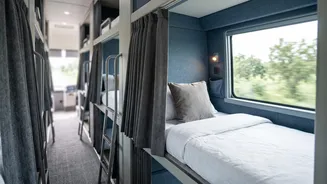
The primary advantage of the upper berth is the immediate sense of privacy it affords. Once you've climbed up, your space is your own, shielded from the general view and bustle of the main cabin. Unlike lower berths, which are at eye level with anyone
walking down the aisle, the upper berth creates a secluded pod. This elevation provides a psychological boundary, making it feel less like a seat in a public vehicle and more like a personal compartment. For solo travelers, especially those seeking to rest without being disturbed or observed, this separation is invaluable. You can draw the curtain, put on your headphones, and create a small, private world, detached from the movement and interactions happening below.
Escaping Aisle Traffic and Interruptions
Overnight bus journeys are rarely static. Passengers board at various stops, people move to use the restroom during scheduled halts, and sometimes vendors come aboard. Most of this activity is concentrated on the lower level. Choosing an upper berth means you are physically removed from this constant foot traffic. You won't have people brushing past your curtain or pausing next to your head. Lower berths often double as impromptu seats for other passengers during stops, a situation upper berth occupants completely avoid. This reduction in disturbances is crucial for getting quality sleep, ensuring you arrive at your destination feeling rested rather than frazzled from a night of intermittent interruptions.
An Enhanced Sense of Security
For many solo travelers, and particularly for women, security is a top priority. An upper berth offers a distinct security advantage. It's more difficult for anyone to casually access your belongings, which can be safely tucked away at the far end of the berth near the wall. The simple act of having to climb up to reach the space acts as a deterrent. Furthermore, some bus operators now offer women-only seating sections or guarantee female co-passengers, but the physical separation of an upper berth provides an additional, structural layer of security regardless of booking policies. This added peace of mind allows for a more relaxed journey, freeing you from the low-level anxiety that can accompany sleeping in a shared public space.
The Lower Berth Counterpoint
Of course, lower berths have their own set of advantages. They are undeniably easier to access, requiring no climbing, which is a significant plus for older travelers, those with mobility issues, or anyone who anticipates needing to get up frequently. They are also generally considered more stable, as the upper berths can experience more sway on winding or bumpy roads. However, for the average solo traveler who prioritizes uninterrupted rest and personal space, these benefits are often outweighed by the constant proximity to aisle noise and activity. The trade-off for easy access is a near-total loss of privacy, a compromise many are unwilling to make on a long overnight journey.
How to Book Your Ideal Berth
Securing a single upper berth is straightforward with online booking platforms. When you view the seat layout, berths are typically arranged in columns. Look for layouts that feature single berths (often labeled 'U' for Upper) that are not paired with another. These are usually 1x2 configurations, with single berths on one side of the aisle and double berths on the other. Avoid booking a 'double sleeper' unless you are traveling with a partner, as some operators may pair you with a stranger. Booking in advance is highly recommended, as single upper berths are a popular choice and tend to sell out quickly, especially on busy routes.