

An Eight-Minute-Old Sun
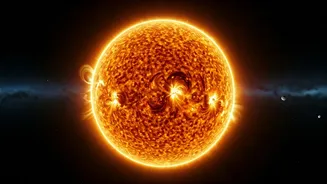
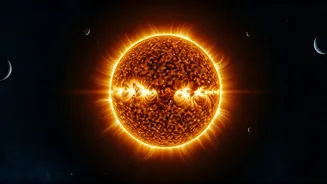
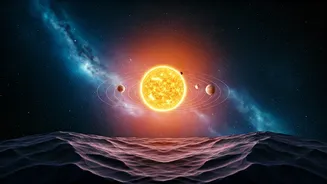
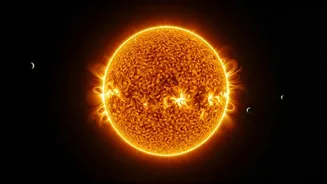
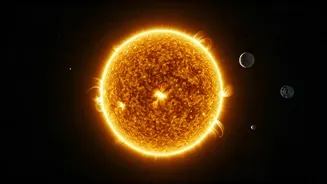
Let's start with the most familiar object in our sky: the Sun. It feels immediate, doesn't it? When the Sun rises, we see it. But that's an illusion. The Sun is, on average, about 150 million kilometres away. Light, while incredibly fast, isn't instantaneous.
It travels at a staggering 300,000 kilometres per second, but it still takes time to cross that vast distance. The sunlight warming your face right now actually left the Sun about 8 minutes and 20 seconds ago. This means if the Sun were to suddenly vanish—don't worry, it won't—we wouldn't know about it for over eight minutes. Every sunrise is, in a way, a historical event. You are always seeing the Sun as it was in the recent past.
Our Closest Stellar Neighbour Is Years Away
The time delay gets much more dramatic when we look beyond our own solar system. The nearest star to us, Proxima Centauri, is about 4.24 light-years away. A light-year is the distance light travels in a year, so the name itself tells you the story. When you spot Proxima Centauri in the night sky, you are seeing light that started its journey more than four years ago. You're seeing the star not as it is tonight, but as it was back when today's primary school children were just being born. Other bright stars are even further in the past. The light from Betelgeuse, the prominent reddish star in the constellation of Orion, takes roughly 642 years to reach us. When you see it, you are looking at light that left the star around the time the Renaissance was flourishing in Europe. For all we know, Betelgeuse could have exploded in a supernova 500 years ago, and we would still have another century and a half to wait before the news arrives in the form of a brilliant, temporary new star in our sky.
A Galactic Time Capsule
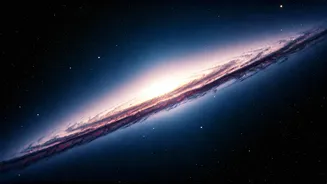
Now, let's go even bigger. On a clear, dark night, far from city lights, you might be able to spot a faint, fuzzy patch in the sky. That is the Andromeda Galaxy, our closest major galactic neighbour. It’s the most distant object you can see with your naked eye, and it is a breathtaking 2.5 million light-years away. The light you see from Andromeda tonight began its journey toward Earth around the time the first early human ancestors, of the genus Homo, were first appearing on our planet. The entire history of modern humanity has unfolded during the time it took for that faint light to cross the intergalactic void and reach your eyes. When we look at Andromeda, we are literally seeing a prehistoric celestial object, a snapshot of a galaxy from a time before our species even began its own journey.
Peeking at the Dawn of Time
This principle—that looking far away is looking back in time—is not just a cool piece of trivia; it's the fundamental tool astronomers use to study the history of the universe. Telescopes are effectively time machines. The further they can see, the older the light they can capture. With powerful instruments like the James Webb Space Telescope (JWST), astronomers are now observing galaxies as they were just a few hundred million years after the Big Bang. For instance, a galaxy named JADES-GS-z14-0 has been confirmed to exist when the universe was only about 290-300 million years old. We are seeing the 'cosmic dawn', the era when the very first stars and galaxies were igniting and shaping the cosmos. These are the universe's baby pictures, light that has been travelling for over 13 billion years to finally reach us, telling the story of creation itself.