
Understanding Your Hair Texture
Before you can find your perfect clip-in match, you need to understand your hair's natural texture and density. Fine hair has a smaller strand diameter and can be prone to oiliness, making it feel silky and light. Medium hair is the most common texture,
with more body than fine hair. Thick or coarse hair has the largest strand diameter, giving it a full and voluminous appearance that can hold styles well. People with thick hair typically need heavier and denser extension sets for a natural blend. For curly and coily hair, the focus shifts to matching your specific curl pattern, which can range from loose waves (Type 2) to tight coils (Type 4). Identifying your primary texture is the first step to ensuring your extensions look like they grew from your own head.
The Best Clip-Ins for Fine Hair
If you have fine hair, the biggest challenges are preventing clips from slipping and avoiding breakage from heavy wefts. The key is to choose lightweight sets, typically under 120 grams. Look for 'seamless' wefts, which have a thin polyurethane base that lies flat against the scalp, making them less visible. You may not need a full set of extensions; sometimes, a few well-placed wefts are enough to add volume where you need it most, like at the sides. To give the clips extra grip, you can gently backcomb the hair at the root or apply a texturising spray before clipping the weft in.
Choosing Extensions for Thick Hair
For those blessed with thick hair, the goal is to match your natural density. Lightweight extensions will look thin and unnatural against a full head of hair. Opt for heavier sets, usually 180 grams or more, which provide enough hair to create a seamless transition from your natural ends to the extensions. Double-drawn extensions, where the hair is thick from top to bottom, are an excellent choice for maintaining uniform fullness. Because you have more natural hair to work with, hiding the clips is generally easier, allowing you to focus on getting a perfect colour and texture match.
Matching Curls and Coils
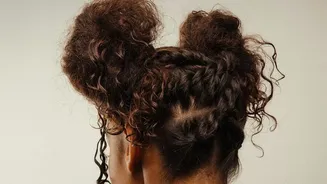
When it comes to curly and coily hair, texture matching is everything. It’s crucial to find extensions that mimic your natural curl pattern, whether it's 3C, 4A, or another type. Many brands now offer extensions specifically designed for textured hair. If you can't find a perfect match, you can style human hair extensions to better blend with your own. You can dampen the extensions and braid them, letting them air dry overnight to create a wave pattern that mimics your own. For a more defined curl, use a small-barrel curling wand on both your hair and the extensions together to unify the texture.
Fuss-Free Style: The Voluminous Ponytail
An elevated ponytail is one of the easiest and most impactful styles you can create with clip-ins. Start by sectioning your hair and applying the wefts, focusing them around the area where your ponytail will sit. For a high ponytail, you can even clip some wefts upside down to ensure they lie flat when you pull your hair up. Once the extensions are secure, gather all your hair into a ponytail and secure it with a hair tie. To conceal the elastic, take a small strand of hair from the ponytail, wrap it around the base, and secure it with a bobby pin for a polished, professional look.
Fuss-Free Style: The Effortless Half-Up
The half-up, half-down style is timeless and perfectly showcases added length and volume. Apply the clip-in wefts primarily to the lower half of your head, starting from the nape of your neck and working your way up to just below your ears. This concentrates the volume where your hair will be worn down. Once the wefts are in, section off the top half of your hair from temple to temple. You can secure it with a decorative clip, twist it into a small bun, or simply tie it back. For a seamless blend, add soft waves to your natural hair and the extensions so they flow together.