




To truly know Kolkata is to walk its streets. Beyond the grand monuments lies the city’s soul, tucked away in centuries-old neighbourhoods where history is not just in museums, but in the air itself. Let's explore these cultural arteries.
North Kolkata: The City’s Old Heartbeat
Often called
the soul of the city, North Kolkata is a sprawling maze of narrow lanes, crumbling yet majestic mansions, and a palpable sense of history. This is where the Bengali elite, or 'babus', prospered during the 19th and early 20th centuries, and their architectural legacy remains. Neighbourhoods like Sovabazar and Shyambazar are dotted with palatial homes, many with intricate cast-iron balconies and green-shuttered windows. A walk here feels like stepping back in time. While some mansions like the Sovabazar Rajbari are famous, especially for a Durga Puja celebration started in 1757, the real magic lies in simply wandering. This part of Kolkata preserves a cultural heritage that feels distinct from the more modern south, offering a glimpse into the city as it once was.
Kumortuli: Where Gods Are Born from Clay
Along the banks of the Hooghly river lies Kumortuli, the traditional potters' quarter. This isn't just a neighbourhood; it's a living workshop where generations of artisans, known as 'Kumors', craft exquisite idols for religious festivals. It is most famous for the thousands of Durga idols created here every year, which are sent across India and even exported abroad. The best time to visit is in the months leading up to Durga Puja (usually August to October), when the lanes are buzzing with activity. You can witness the entire idol-making process, from the straw frames to the final, painted forms. Walking through these alleys provides a fascinating insight into the blend of art, faith, and commerce that defines much of Kolkata’s cultural life.
College Street: A Paradise for Book Lovers
Known as 'Boi Para' or 'Book Town', College Street is the largest second-hand book market in India and one of the biggest in the world. For nearly a kilometre, pavements are lined with makeshift stalls selling everything from rare first editions and academic textbooks to popular fiction and old magazines. But College Street is more than just a market; it's the intellectual heart of the city. It is home to prestigious institutions like Presidency University and the University of Calcutta, which have shaped Bengal's cultural and political landscape for centuries. No visit is complete without stopping at the Indian Coffee House, a legendary café where students, scholars, and artists have gathered for decades for spirited discussions, a practice known locally as 'adda'.
The Colonial Core: B.B.D. Bagh
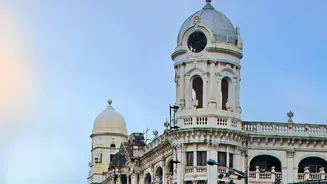
Formerly Dalhousie Square, B.B.D. Bagh was the administrative and commercial centre of British India when Kolkata was the capital. The area is a stunning showcase of colonial architecture, with grand structures like the Writers' Building, the General Post Office, and St. John's Church. A walk here reveals how the East India Company and later the British Raj projected power through urban planning. While some buildings have aged gracefully, others show the beautiful decay of peeling paint and crumbling walls, each telling a story of the passage of time. It stands in contrast to the organic lanes of North Kolkata, offering a more structured but equally fascinating historical perspective.
A Taste of Old Kolkata
Exploring these neighbourhoods is incomplete without sampling their culinary heritage. In North Kolkata, centuries-old sweet shops like Girish Chandra Dey & Nakur Chandra Nandy offer legendary 'sandesh'. Around College Street, 'cabin' restaurants like Dilkhusha Cabin serve iconic snacks like 'kabiraji' cutlets. The kathi roll, a now-famous street food, has its origins at Nizam's, where grilled kebabs were wrapped in a paratha for easy eating. And in Shyambazar, Golbari is an institution famous for its 'kosha mangsho', a slow-cooked mutton dish with a distinctively dark, rich gravy. These flavours are as much a part of the city's culture as its buildings and books.