


A Storm Unlike Any Other
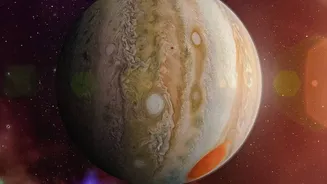
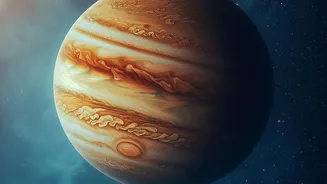
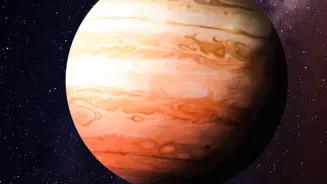
Jupiter’s Great Red Spot is a colossal anticyclonic storm, a high-pressure system that has been raging in the planet's southern hemisphere for at least 150 years, and possibly much longer. Historically, it was vast enough to swallow three Earths side-by-side.
Today, it’s about 1.3 times the width of our entire planet. Unlike hurricanes on Earth that lose power over land, Jupiter has no solid surface to slow it down, allowing this storm to persist for centuries, driven by the planet's powerful jet streams. Its famous reddish-orange hue is believed to be the result of chemicals like ammonia or other compounds in the upper atmosphere reacting with sunlight, though its exact composition remains a mystery that scientists are still trying to solve.
The Shrinking, Shifting Spot
For the last century, astronomers have watched the Great Red Spot shrink. What was once a large oval is becoming more circular. While its width was once measured at over 40,000 kilometers, recent observations from the Hubble Space Telescope and NASA's Juno spacecraft show it is now just over 16,000 kilometers across. Some observations show the rate of shrinking has accelerated at times, losing hundreds of miles in diameter per year. Recent data has also revealed unexpected behavior. Astronomers using Hubble discovered the storm appears to jiggle, squeezing in and out while its rotational speed changes, a phenomenon that has yet to be fully explained. The color is also changing, with its once-vibrant red fading to a paler orange or salmon color, and its distinct core becoming less defined.
What the New Images Reveal
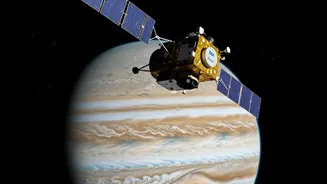
Data from NASA's Juno mission, which makes close flybys of Jupiter, has provided unprecedented detail. The latest images have revealed intricate structures within the storm, including a unique, wispy filamentary feature twisting within its core. These high-resolution visuals also show smaller eddies and storms being pulled into the main vortex. One leading theory suggests these smaller storms act as a food source, feeding the Great Red Spot and sustaining its energy. A recent study using 3D simulations proposed that the current shrinking trend could be caused by a reduction in the number of these smaller storms available to be 'eaten' by the larger one, essentially starving the behemoth. The storm isn't just a surface feature either; Juno's instruments have shown it is incredibly deep, extending more than 300 kilometers down into Jupiter's atmosphere.
The Future of a Landmark
The big question scientists are now asking is whether the Great Red Spot will eventually disappear. Based on its current rate of shrinkage, some projections suggest it could become circular by 2040, though its ultimate fate is unknown. It's possible that this shrinking is part of a long-term cyclical fluctuation and that the storm could grow again. However, some researchers believe we may be the last generation to witness the storm in its 'Great' form. History provides a curious precedent; a 'Permanent Spot' observed by astronomer Giovanni Cassini in the 17th century later vanished, and some studies suggest it was a different storm entirely from the one we see today. As the Great Red Spot changes, astronomers are also watching other storms on Jupiter, like 'Red Spot Jr.', which formed from the merger of smaller white ovals and could offer clues about the lifecycle of these giant weather systems.