
A Storm Within a Storm
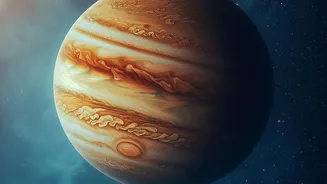
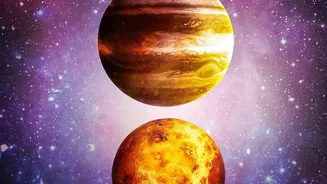
For centuries, astronomers have tracked the Great Red Spot, a gigantic anticyclone that has been raging in Jupiter's southern hemisphere for at least 300 years. While the storm itself has been famously shrinking for the past century, scientists have now
turned their attention to its complex internal structure. Using the powerful new capabilities of the James Webb Space Telescope (JWST), researchers have uncovered a fascinating new layer of detail: smaller vortices, or 'cosmic tornados', swirling within the main storm. Recent findings show that these secondary storms are not static; they evolve, interact, and appear to be shrinking themselves, providing a treasure trove of new data on the mysterious dynamics of Jupiter's atmosphere. This discovery offers a fresh perspective on what powers the most powerful storm in the solar system.
The Power of New Eyes
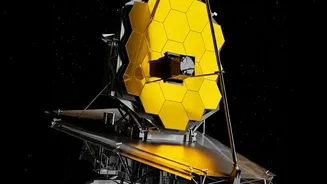
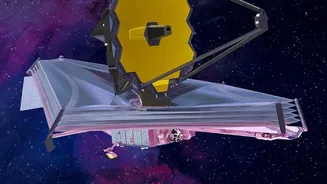
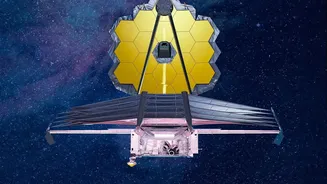
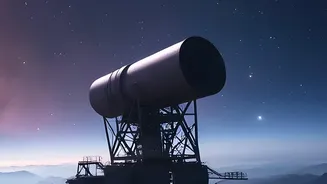
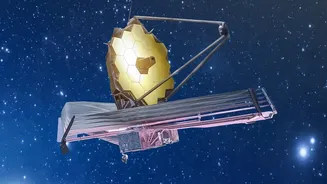
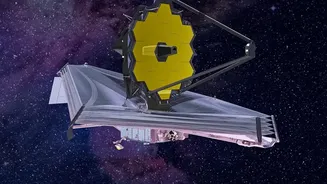
These groundbreaking observations were made possible by the James Webb Space Telescope, specifically its Near-Infrared Spectrograph (NIRSpec) and Mid-Infrared Instrument (MIRI). Unlike the Hubble Space Telescope, which primarily sees in visible and ultraviolet light, JWST is designed to capture infrared light. This allows it to pierce through the high-altitude hazes of Jupiter's atmosphere and measure the temperature and chemical composition of the clouds below. Scientists from the University of Leicester, who were heavily involved in developing the MIRI instrument, used it to create detailed thermal maps of the Great Red Spot. These images revealed unexpected patchiness and temperature variations inside the storm, indicating differences in cloud thickness and structure that were previously invisible. The ability to see these features is a significant leap forward, turning a previously 'boring' region of the atmosphere into a hotbed of scientific interest.
What Are These Cosmic Tornados?
The term 'cosmic tornados' is a helpful analogy for what are scientifically known as vortices or anticyclones. Like the Great Red Spot itself, these are high-pressure systems, but on a much smaller scale. Previous studies have noted that the Great Red Spot appears to 'feed' on smaller storms to sustain its energy. The new JWST data provides a more intimate look at this process. The observations reveal how these smaller eddies move, merge, and dissipate within the larger storm's structure. By analyzing the flow of heat and gases, scientists can better understand the delicate energy balance that has kept the Great Red Spot alive for so long. The shrinking of these smaller features may be directly linked to the overall shrinking of the main storm, suggesting that its long-term survival depends on this diet of smaller vortices.
Solving the Great Red Spot's Mystery
The biggest question surrounding the Great Red Spot is its longevity and its ultimate fate. Since the 1800s, it has shrunk from being wide enough to swallow three Earths to just about the diameter of our own planet. The new findings add a critical piece to this puzzle. Some numerical simulations suggest that without being fed by smaller storms, the Great Red Spot would shrink significantly over just a few years. The observation of these internal vortices and their behaviour provides real-world evidence supporting these models. By studying how these smaller storms transfer energy and momentum to the main vortex, scientists hope to build a complete model of the storm's life cycle. This will not only help predict whether the Great Red Spot will eventually disappear but will also deepen our understanding of fluid dynamics on a planetary scale, with implications for studying atmospheres on other planets and even here on Earth.