


A Sweet Find in the Stars
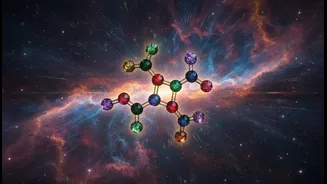
Scientists have announced the first-ever confirmed detection of a true sugar in interstellar space. The molecule, called erythrulose, was identified in a vast and dense cloud of gas and dust named G+0.693-0.027, located near the center of our Milky Way
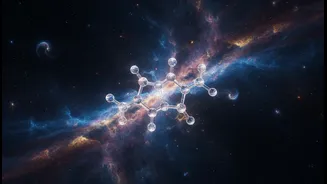
galaxy, about 26,700 light-years from Earth. Erythrulose is a four-carbon sugar, which on Earth is found in things like raspberries. While it doesn't mean life has been found, it’s a crucial discovery that proves some of life's key chemical ingredients can form in the void of space, long before planets exist.
How They Found It
An international team of researchers, led by scientists from the Spanish National Research Council, used powerful radio telescopes in Spain to make the discovery. Every molecule emits a unique radio signal, like a fingerprint. By pointing the Yebes 40-meter and IRAM 30-meter telescopes at the molecular cloud, they detected 12 distinct radio signals that perfectly matched the signature of erythrulose. This cloud is well-known as a cosmic factory, containing a rich variety of organic molecules, but the discovery of a four-carbon sugar was a significant surprise.
Why This Discovery is Surprising
The discovery of erythrulose challenges a long-standing theory in astrochemistry. Scientists previously believed that complex molecules in space grow sequentially, adding one carbon atom at a time. However, the team found that erythrulose, a four-carbon sugar, was at least eight times more abundant than any simpler three-carbon sugars in the same cloud. In fact, no three-carbon sugars were detected at all, despite the survey's high sensitivity. This suggests that the pathways to forming complex organic matter in space are more varied and perhaps more efficient than we once thought, with larger molecules possibly forming on the surface of dust grains.
A First for Cosmic Chemistry
This finding is notable for several reasons. At 14 atoms, erythrulose is one of the largest and most complex non-cyclic molecules ever found in the interstellar medium. It's also the first molecule detected in space containing four oxygen atoms. Furthermore, it is only the second 'chiral' molecule ever found in space. Chiral molecules exist in two mirror-image forms, like left and right hands, a property crucial to the function of many biological molecules, including the amino acids and sugars that make up life on Earth. The presence of such a molecule in space opens up new avenues for understanding how this fundamental asymmetry of life could have originated.
The Bigger Picture: Ingredients for Life
Sugars are fundamental to life as we know it. They form the backbone of DNA and RNA and serve as a primary energy source for cells. While sugars like ribose have been found in meteorites that have landed on Earth, this is the first time a true sugar has been spotted directly in the interstellar gas from which stars and planets form. This lends powerful support to the theory that the essential ingredients for life didn't necessarily have to form on early Earth but could have been delivered by comets and asteroids that inherited these molecules from the interstellar cloud where the solar system was born.