



The Moon’s Hidden Sanctuaries
Before we can build lunar bases, we need a safe place to put them. The Moon's surface is an unforgiving place, lacking an atmosphere to shield it from intense solar radiation, cosmic rays, and micrometeoroid impacts. Temperatures swing wildly from scorching
heat to bone-chilling cold. However, scientists believe a network of vast, underground tunnels could offer a solution. These are lava tubes, colossal caverns forged billions of years ago by flowing magma. When the surface of ancient lava rivers cooled and hardened, the molten rock inside continued to flow, eventually draining out and leaving behind enormous hollow conduits. These tubes, potentially hundreds of meters wide, are protected by thick ceilings of solid rock. This natural overhead shielding provides near-perfect protection from radiation and meteorites, and maintains a stable, albeit cold, internal temperature around -20°C. These features make them prime real estate for future human settlements.
A Perilous Exploration Problem
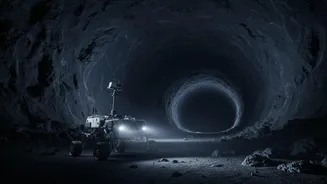
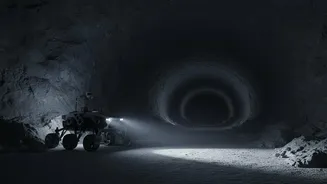
While lava tubes are promising, they are a complete mystery. We’ve only seen their potential entrances – 'skylights' where a section of the tube’s roof has collapsed, leaving a deep pit. Some of these pits are massive, wider than a football field and descending over 100 meters into darkness. Before sending humans, we must send robots to scout these subterranean realms. But exploring them presents immense challenges. The entrances are often sheer drops, the terrain inside is unknown and likely treacherous, and it's completely dark. Communication is another major issue; radio signals cannot penetrate deep into a cave. Furthermore, traditional solar-powered rovers would be useless without sunlight. Any machine sent into these pits needs to be incredibly resilient, navigate autonomously, and have a power source that doesn't rely on the sun.
Enter the Cave Crawlers
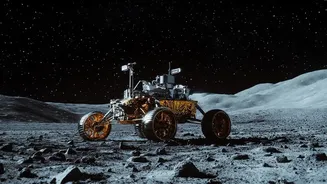
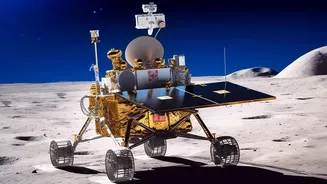
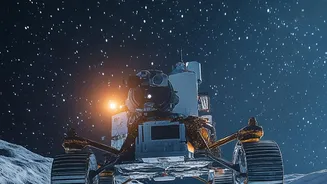
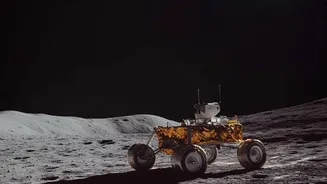
To solve this unique problem, space agencies and universities are designing a new class of specialized robots. The European Space Agency (ESA) has been studying several concepts, with a leading candidate being a spherical probe called DAEDALUS (Descent And Exploration in Deep Autonomy of Lunar Underground Structures). The 46-cm sphere is designed to be tough, protecting its internal cameras, LiDAR for 3D mapping, and sensors. The concept involves lowering DAEDALUS into a pit via a tether from a lander. Once at the bottom, it would disconnect and roll autonomously to begin its survey. Another ESA-backed concept combines a robotic crane (RoboCrane) to lower the explorer and also provide a power and communication link. In the US, companies like Astrobotic and its partner Carnegie Mellon University are developing rovers like MoonRanger, a small, autonomous vehicle designed specifically to investigate lunar pits and search for ice. A more recent NASA-funded concept from Stone Aerospace proposes a hovering drone that would be powered by a laser beamed through a fiber-optic tether from a rover on the surface.
The Robotic Mission Roadmap
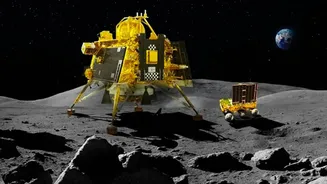
The game plan for exploring these caves is unfolding in stages. First, orbiters map the surface to identify promising pit locations, like those in the Marius Hills region. The next step involves a lander touching down near one of these skylights. From there, a multi-part mission would commence. As envisioned by ESA's studies, a surface rover would carry a system like RoboCrane to the edge of the pit. The crane would then carefully lower a probe like DAEDALUS down into the cavern, allowing it to scan the pit walls on its descent. Once at the bottom, the probe would autonomously explore the initial section of the lava tube, creating detailed 3D maps and analyzing the geology. This data would be relayed back to the surface lander and then to Earth, giving scientists their first-ever direct look inside these hidden lunar worlds and assessing their suitability for habitation.