



What Did Webb Actually Find?
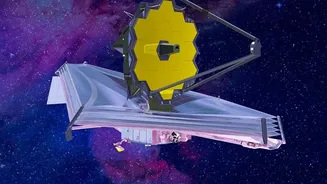
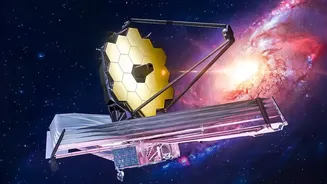
Scientists using the revolutionary JWST have identified the chemical signature of water vapour in the atmosphere of an exoplanet, a planet orbiting a star other than our sun. While water has been found on gaseous giants before, finding its signature around
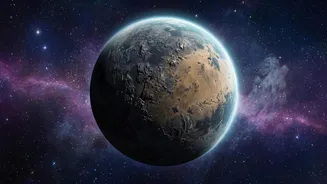
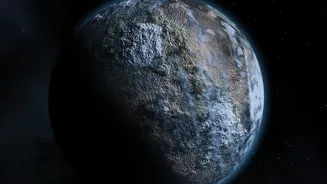
a rocky, albeit larger, planet is a thrilling development. The term 'super-Earth' refers to a class of planets with a mass higher than Earth's but substantially below that of our solar system's ice giants like Neptune. These planets are among the most common types discovered in our galaxy, yet none exist in our own solar system, making them objects of intense scientific curiosity. The specific detection of water vapour marks a crucial moment in astronomy, confirming that a key ingredient for life as we know it can exist in the atmospheres of rocky worlds in other star systems.
The Art of Reading Starlight
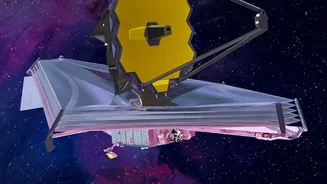
This remarkable feat was achieved using a technique called transit spectroscopy. As the exoplanet passed in front of its host star from our perspective, the star's light filtered through the planet's atmosphere. The powerful instruments aboard the JWST, specifically its spectrographs, analysed this light with incredible precision. Every chemical element and molecule absorbs light at unique wavelengths, creating a sort of chemical 'barcode' in the light's spectrum. By reading this barcode, astronomers can determine the composition of a planet's atmosphere from light-years away. In this case, the instruments picked up the distinct, tell-tale signs that can only be attributed to water molecules (H2O), marking the most detailed observation of its kind.
Not Quite Earth 2.0 (Yet)
It is crucial to temper excitement with scientific reality. The presence of water vapour does not automatically mean the discovery of life or even a habitable ocean world. Many super-Earths orbit very close to their stars, resulting in scorching surface temperatures that would make liquid water impossible. For example, previous studies of the rocky exoplanet GJ 486 b showed hints of water vapour, but its surface temperature is around 430 degrees Celsius, far too hot for habitability. The significance of the latest finding is not that this specific planet is habitable, but that Webb has proven its ability to detect this vital molecule on a rocky world. It validates the technology and methods that will be used to survey more promising candidates in the future — planets that are in the 'habitable zone' of their star, where conditions might be just right for liquid water to exist on the surface.
Why Super-Earths Are So Intriguing
Super-Earths represent a fascinating puzzle for astronomers. With radii and mass somewhere between Earth and Neptune, scientists are unsure if they are more like giant, rocky versions of our own planet or small, gassy versions of Neptune. Some could be 'water worlds,' with deep global oceans, a type of planet theorized by astronomers for years. The discovery of water vapour adds a critical piece to this puzzle. It suggests that, under the right conditions, these common planets could indeed retain atmospheres rich in volatile compounds like water. This opens up countless new targets in the search for worlds that might have the right ingredients for life, even if they look nothing like the planets in our immediate cosmic neighbourhood.