




The Case of the Impossible Early Galaxies
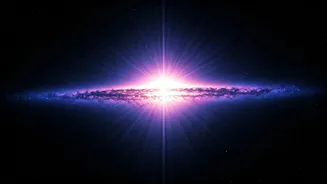
The first major clue that something was amiss came from the cosmic dawn, the era just a few hundred million years after the Big Bang. According to the standard model of cosmology, known as Lambda-CDM, the first galaxies should have been small, messy,
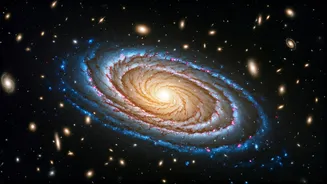
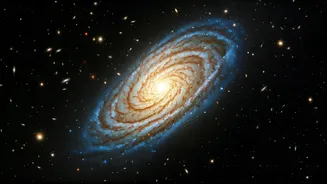
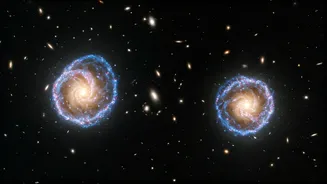
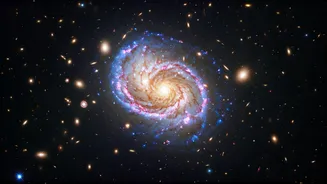
and taken a long time to grow. Instead, JWST started finding galaxies that were bafflingly large, bright, and well-formed far earlier than anyone predicted. One such galaxy, JADES-GS-z14-0, was found to exist just 290 million years after the Big Bang, yet it was already surprisingly mature. It's like finding a fully built skyscraper in a photograph of what should be an empty field. These discoveries sent a shockwave through the astronomical community, suggesting that either the first stars were far more efficient at building galaxies than thought, or our timeline of the early universe is fundamentally flawed. Scientists were astounded, realizing the universe revealed by Webb simply didn't square with existing theories.
Conflicting Reports on Cosmic Expansion
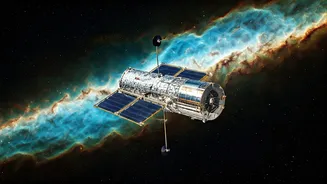
Another perplexing mystery is the 'Hubble Tension'. For years, cosmologists have been debating how fast the universe is expanding. There are two main ways to measure this value, known as the Hubble Constant. One method looks at the ancient light from the early universe (the cosmic microwave background) and predicts a value of around 67 kilometers per second per megaparsec. The other method measures distances to nearby stars and supernovae, and it consistently returns a higher value of around 73. Many hoped JWST, with its incredibly sharp infrared vision, would settle the dispute. It was thought that perhaps the Hubble Space Telescope's measurements were slightly off due to dust or crowded starfields. However, JWST's more precise observations have largely confirmed Hubble's findings, deepening the tension instead of resolving it. This persistent disagreement suggests it's not just a measurement error; it could point to new physics or unknown ingredients in our cosmic recipe.
Questioning the Usual Suspects
When clues don't add up, detectives start re-examining their assumptions. For cosmologists, this means putting the standard Lambda-CDM model itself under interrogation. This model is built on key ingredients, primarily dark energy (the mysterious force accelerating cosmic expansion) and cold dark matter (the invisible scaffolding upon which galaxies are built). For decades, this model has successfully explained a vast range of cosmic observations. But the anomalies found by JWST are applying serious pressure. For example, some early galaxies appear not only too massive but also too elongated, a shape that doesn't fit neatly with predictions from cold dark matter simulations. This has led some scientists to explore alternative ideas, such as 'warm' or 'wave' dark matter, which might better explain the structures JWST is seeing. While no one is ready to throw out the standard model just yet, it is facing some of its toughest questions to date.
The Hunt for More Evidence
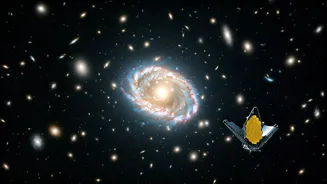
Like any good detective, astronomers know the only way to solve the case is to gather more evidence. The puzzles presented by JWST have sparked a wave of new theories and research directions. Scientists are now using the telescope's powerful spectrographs to dissect the light from these early galaxies, analyzing their chemical composition for more clues about the first generation of stars. They are mapping the cosmic web, the vast filamentary structure of the universe, in greater detail than ever before to see how these early, massive structures fit in. Each new observation is another piece of the puzzle. The telescope's ability to peer through dust clouds is also revealing the chaotic, messy birth of stars in ways that were previously hidden, providing context for how galaxies grow and evolve. The goal is to determine whether these strange findings are exceptional outliers or the new normal, which would force a fundamental rewrite of our understanding of cosmic history.