





A Legacy Spanning Millennia
Shrikhand’s story is as rich and layered as the dessert itself, with roots tracing back to ancient India. Food historians suggest that a similar dish, known as 'Shikharini', was first noted around 500 BC. The name itself is a beautiful blend of history,
believed to be derived from the Sanskrit 'ksheera' (thickened milk) and the Persian 'qand' (sweet). This delectable sweet originated in the western states of Maharashtra and Gujarat, evolving from a simple preparation of strained yogurt enjoyed by travelling herders into a dish fit for royalty and commoners alike. Its prominence grew significantly during the Maratha period, cementing its place in celebratory meals for festivals like Gudi Padwa and Diwali.
The Art of Simplicity
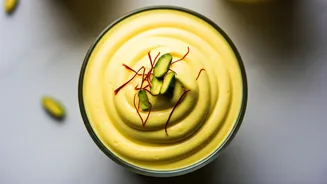
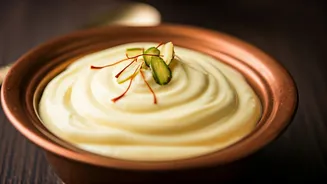
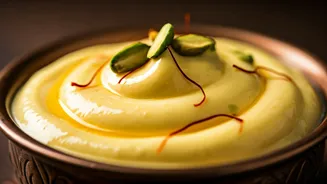
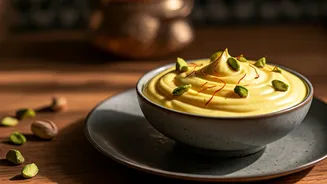
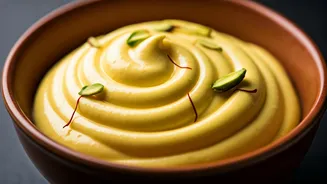
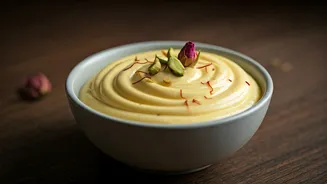
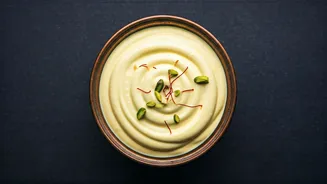
The magic of shrikhand lies in its transformation of a humble ingredient: yogurt. The traditional process is a patient one, involving hanging fresh curd in a muslin cloth for several hours, sometimes overnight. This allows the whey to drain away, leaving behind a thick, concentrated, and unbelievably creamy mass called 'chakka' in Marathi. This 'hung curd' is the canvas. It's then gently blended with fine sugar, which dissolves to create a velvety smooth texture. The final, crucial touches are the aromatics: fragrant green cardamom and the star of the show, saffron, which imparts its signature golden colour and delicate flavour.
The Heart of Indian Celebrations
No festive thali in Maharashtra or Gujarat feels complete without a serving of shrikhand. It is an indispensable part of celebrations like Gudi Padwa, the Maharashtrian New Year, where it is served with hot, fluffy puris. This classic combination of sweet shrikhand and savoury puri is a beloved culinary tradition. The dessert is also a staple during Janmashtami, celebrating Lord Krishna's fondness for milk and dairy products. Beyond grand festivals, shrikhand symbolises joy and good fortune in households, often eaten before starting a new venture or on a special occasion, turning any meal into a celebration.
An Endlessly Versatile Classic
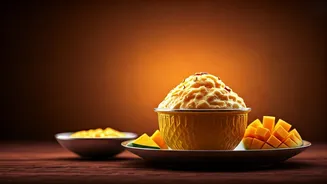
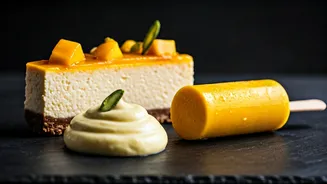
While the classic kesar elaichi (saffron-cardamom) shrikhand remains the undisputed favourite, the dessert’s simple base makes it incredibly adaptable. Perhaps the most famous variation is Amrakhand, a luscious blend of shrikhand and ripe mango puree that captures the essence of Indian summers. But the innovation doesn't stop there. Modern chefs and home cooks experiment with a kaleidoscope of flavours. You can find everything from rose and almond shrikhand to more contemporary versions featuring sitafal (custard apple), black currant, and even kala jamun. This willingness to evolve is a key reason for its enduring appeal.
The Modern Shrikhand Story
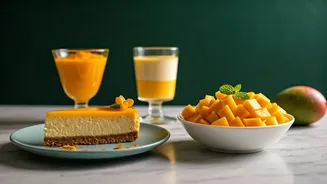
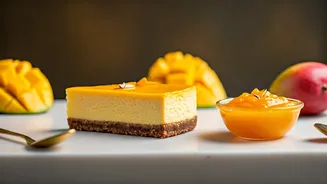
In an era of global food trends and complex fusion cuisine, shrikhand's dominance speaks volumes about its timeless appeal. Its popularity has led to creative fusion desserts, such as shrikhand trifles, tarts, and mousses, which introduce the classic flavour to a new generation in exciting formats. Even with these modern twists, the soul of the dessert remains intact. It is a healthy indulgence, packed with the goodness of probiotics from the yogurt. Whether enjoyed in a traditional steel bowl or a fancy shot glass, shrikhand continues to be a symbol of comfort, tradition, and pure, unadulterated joy.