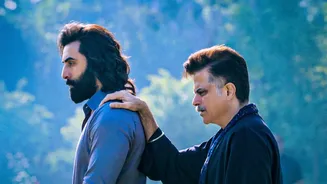







The Rise of the Romantic Hero
Coming from the illustrious Kapoor dynasty, Ranbir Kapoor’s entry into Bollywood was met with monumental expectations. His debut in 2007's 'Saawariya', though a commercial failure, established his on-screen persona as a charming, boyish lover. This image
was solidified with subsequent hits like 'Bachna Ae Haseeno' (2008) and the coming-of-age story 'Wake Up Sid' (2009). In these films, Kapoor played relatable, often flawed, young men navigating love and life in contemporary India. Films like 'Ajab Prem Ki Ghazab Kahani' (2009) further cemented his status as the 'chocolate boy' of his generation, a reliable face for romantic comedies. This early phase built him a massive youth following and established him as a bankable star.
The First Hint of Rebellion
Just as audiences grew comfortable with his romantic image, Kapoor took a sharp left turn. In 2010, he starred in Prakash Jha's political thriller 'Raajneeti'. Portraying a character inspired by both Arjuna from the Mahabharata and Michael Corleone from 'The Godfather', he delved into a world of murky politics and ruthless manipulation. This was a stark departure from the lighthearted roles he was known for, and critics took notice, praising his ability to hold his own amongst veteran actors like Nana Patekar and Ajay Devgn. The following year, he delivered what many consider a career-defining performance in 'Rockstar' (2011). As the self-destructive musician Jordan, Kapoor embraced a role layered with angst, passion, and pain, proving he was not just a star, but a serious actor willing to explore darker emotional landscapes.
Mastering the Unconventional
If 'Raajneeti' and 'Rockstar' were signals of intent, 'Barfi!' (2012) was the confirmation. Kapoor played a deaf and mute man in Anurag Basu's critically acclaimed comedy-drama. The role, which relied entirely on physical comedy and subtle expression, was a massive gamble. Without the crutch of dialogue, his performance was a masterclass in non-verbal communication, earning him widespread praise and solidifying his reputation for taking on unconventional challenges. This was followed by more nuanced performances in films like 'Tamasha' (2015), where he played a man battling with his true identity against the pressures of a monotonous life. These choices demonstrated a clear artistic vision: to prioritize complex characters over easy commercial wins.
The Biopic Challenge and Mainstream Dominance
In 2018, Ranbir Kapoor took on his biggest challenge yet: portraying controversial actor Sanjay Dutt in the biopic 'Sanju'. The role required significant physical transformation and the ability to capture the essence of a well-known public figure without slipping into mimicry. His portrayal was hailed as one of the finest in modern Indian cinema, and the film was a colossal commercial success. This achievement proved that Kapoor could merge his artistic ambitions with massive box office appeal. He had successfully transitioned from being just a critically-acclaimed actor to a superstar who could carry a complex film to blockbuster heights purely on his performance.
Embracing Morally Grey Characters
In recent years, Kapoor has pushed the boundaries even further. His role as the volatile and morally ambiguous protagonist in 'Animal' (2023) was a deliberate choice to shatter any remaining vestiges of his 'chocolate boy' image. The character, driven by a toxic and obsessive relationship with his father, was intense and divisive, sparking widespread debate. Kapoor himself stated that he wanted to explore a multi-dimensional and complex character to surprise audiences and evolve as an actor. The film's staggering success demonstrated that audiences were not only ready but eager to see him in these darker, more challenging roles, cementing his reach beyond just urban centres to the masses.