





A New Wanderer in the Darkness
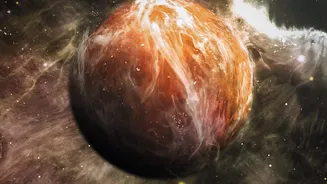
In the cold, dark expanse beyond Neptune, a new object has captured the attention of the astronomical community. Provisionally named 2026 ED138, this trans-Neptunian object (TNO) was recently identified using data from the Vera C. Rubin Observatory in Chile.
Its discovery was announced in late October 2026 by the International Astronomical Union's Minor Planet Center. What makes this celestial body special is its significant brightness and distance, which suggest it is unusually large. Initial estimates place its diameter somewhere between 600 and 1,500 kilometres. This discovery was made possible by powerful new survey technologies that can sift through billions of points of light to find faint, moving objects against the crowded backdrop of stars, particularly as ED138 was found near the plane of the Milky Way, a region often avoided in such searches.
The Dwarf Planet Rulebook
So, what does it take to become a dwarf planet? The classification was formally defined by the International Astronomical Union (IAU) in 2006, the same year Pluto was famously reclassified. According to the IAU, a celestial body must meet four criteria. First, it must orbit the Sun. Second, it must not be a satellite (or moon) of another planet. Third, it must not have 'cleared the neighbourhood' around its orbit, meaning it shares its orbital space with other objects—this is the key rule that separates dwarf planets from the eight major planets. Finally, and most crucially for 2026 ED138, it must have enough mass for its own gravity to pull it into a nearly round shape. This state is known as hydrostatic equilibrium.
The Crucial Test of Roundness
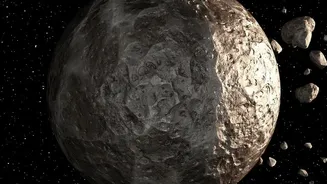
The question of whether 2026 ED138 is a dwarf planet hinges on hydrostatic equilibrium. This is the state where the inward pull of an object's own gravity is balanced by the outward push of its internal pressure. For an object made of rock and ice, this gravitational self-sculpting only happens once it reaches a certain size, forcing it into a spherical or ellipsoidal shape. Objects that are too small and lack sufficient mass, like many asteroids, have irregular, lumpy shapes. The preliminary size estimates for 2026 ED138 put it well within the range of other confirmed dwarf planets like Pluto, Eris, and Makemake. However, its size must be confirmed with further observations, likely using infrared telescopes, which can give a better measure of an object's physical dimensions regardless of how reflective its surface is.
Why Finding These Objects Matters
Discovering a new dwarf planet candidate isn't just about adding another name to a list. These distant worlds are invaluable scientific treasures. Located in the Kuiper Belt, a vast donut-shaped region beyond Neptune, objects like 2026 ED138 are frozen relics from the dawn of our solar system. Because they are so far from the Sun, they have remained largely unchanged for billions of years, preserving the raw materials from which the planets were formed. Studying their composition, size, and orbits helps scientists piece together the chaotic history of our solar system's formation, including how the giant planets may have migrated to their current positions. Each new discovery provides another clue to this grand cosmic puzzle and refines our understanding of how planetary systems, including our own, come to be.