






The Ocean's Rising Fever
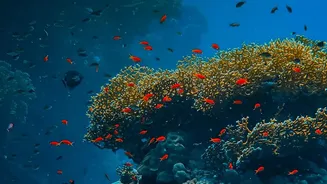
Coral reefs are the vibrant, bustling cities of the sea, supporting nearly a quarter of all marine life. They are also profoundly sensitive. Many corals live in a delicate partnership with microscopic algae called zooxanthellae. These algae live within
the coral's tissues, providing up to 85% of their food through photosynthesis and giving them their brilliant colours. But when ocean temperatures rise even slightly, this relationship breaks down. The stressed coral expels the algae, leaving its own white skeleton visible through its transparent tissue. This is bleaching. While not immediately fatal, a bleached coral is essentially starving and vulnerable to disease. With marine heatwaves becoming more frequent and intense, bleaching events are pushing reefs worldwide to the brink.
What Is Thermal Resilience?
Amidst the crisis, scientists have observed something remarkable: not all corals bleach. Even in the same area, some colonies remain colourful and healthy while their neighbours turn white. This capacity to withstand heat stress is called thermal resilience. It's a coral's natural ability to resist or recover from the damaging effects of unusually high temperatures. This resilience can stem from several factors, but a primary one involves the very algae that abandon them during bleaching. Some corals are fortunate enough to host hardier, more heat-tolerant strains of zooxanthellae. Think of it as having a roommate who can handle the heat when things get uncomfortable, allowing the partnership to continue, and the coral to stay fed and healthy.
Nature's Survival Toolkit
A coral's ability to endure heat isn't just about luck; it's written in its biology. Some resilience comes from the coral's own genetics, making it naturally tougher. Studies show that some heat-adapted corals can even pass these resilient traits on to their offspring, preparing the next generation for warmer seas. Another mechanism is the ability to 'shuffle' symbionts. Some corals can swap out their heat-sensitive algae for more robust strains when temperatures rise. This adaptability allows them to persist and recover even during a prolonged heatwave. Scientists have found these 'super corals' in naturally extreme environments, like the lagoons of French Polynesia where daily temperatures can swing dramatically, conditioning the corals to be exceptionally tough.
Harnessing the Power of Super Corals
Understanding this natural resilience has opened a new frontier in reef conservation. Rather than just protecting reefs, scientists are now actively working to boost their resilience. Projects around the globe, including in India's own Gulf of Mannar, are focusing on coral restoration. One promising strategy is 'assisted evolution', where scientists identify naturally heat-resistant corals, and then selectively breed them to create even tougher offspring. Others are experimenting with 'stress-hardening', where corals grown in nurseries are exposed to non-lethal high temperatures to build their tolerance before being planted out on degraded reefs. The goal is to create networks of resilient reefs that can act as sources of tough coral larvae, helping to repopulate other areas.
A Powerful Tool, Not a Magic Bullet
While thermal resilience offers a profound sense of hope, it is not a cure-all. Even the toughest 'super corals' have their limits and can bleach under extreme or prolonged heat stress. More importantly, thermal resilience does not protect corals from other major threats like ocean acidification, which makes it harder for them to build their skeletons, or local stressors like pollution, overfishing, and coastal development. These pressures weaken reefs, making them less able to bounce back from any disturbance, including bleaching. Experts agree that while harnessing thermal resilience is a critical strategy to buy reefs precious time, it cannot work in isolation. It must be paired with strong local conservation efforts and, most importantly, a global reduction in the carbon emissions that are warming our oceans in the first place.