




Our Planetary Neighborhood Watch
Our cosmic backyard is filled with what astronomers call Near-Earth Objects, or NEOs. These are comets and asteroids whose orbits bring them within about 45 million kilometres of Earth's path around the Sun. While a catastrophic impact is a rare event,
the 2013 Chelyabinsk incident in Russia, caused by a relatively small 20-meter asteroid that no one saw coming, was a stark reminder of the potential danger. This is why NASA established the Planetary Defense Coordination Office (PDCO) in 2016, tasked with finding, tracking, and understanding these objects. The first step in protecting our planet is knowing what's out there.
From Slow Scans to Rapid Surveys
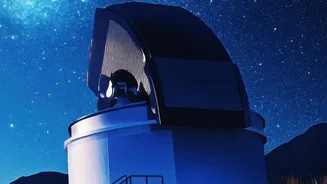
For much of astronomical history, finding asteroids was a slow, painstaking process. An astronomer would compare photographic plates taken hours or days apart, manually searching for a single point of light that moved against the fixed background of stars. Today, the game has completely changed. We are in the era of automated, robotic survey telescopes that scan the entire visible sky multiple times a night. Projects like the Catalina Sky Survey (CSS) in Arizona, Pan-STARRS in Hawaii, and the Asteroid Terrestrial-impact Last Alert System (ATLAS) form the backbone of this modern detection network. These systems are designed not just to find asteroids, but to do so with incredible speed and efficiency.
The Hardware Behind the Hunt
The key to modern asteroid detection is a combination of wide-field telescopes and massive digital cameras. Unlike traditional telescopes that focus on a tiny patch of sky, survey telescopes have a very large field of view. For instance, an ATLAS telescope can see an area of the sky about 15 times the diameter of the full moon. These telescopes are equipped with powerful cameras featuring large-format, charge-coupled devices (CCDs) that are highly sensitive to faint light. The Pan-STARRS PS1 telescope, for example, has been described as the world's largest digital camera, snapping hundreds of photos each night to be analyzed.
Software That Makes It 'Real-Time'
The term 'real-time' doesn't mean we see an asteroid the second it enters our cosmic vicinity. Instead, it refers to the incredible speed of the data processing pipeline. Here's how it works: a telescope like ATLAS takes a series of four images of the same patch of sky, separated by a few minutes. Powerful computer systems immediately analyze these images, searching for any object that has changed position. This is where the 'real-time' detection happens. Sophisticated software, like the Moving Object Processing System (MOPS) used by Pan-STARRS, automatically links these moving dots, calculates a preliminary orbit, and checks it against a database of all known objects. This entire process, from taking the picture to identifying a potential new NEO, can happen in minutes.
From a Telescope to a Global Alert
Once a survey telescope's software flags a new, unknown object, the information is sent almost instantly to the Minor Planet Center (MPC), the global clearinghouse for all small-body observations. The MPC posts these findings on a public confirmation page, which astronomers—both professional and amateur—around the world constantly monitor. Other observatories then perform follow-up observations to gather more data points, helping to refine the object's orbit with greater precision. If the calculated trajectory shows a potential risk to Earth, NASA's Center for Near-Earth Object Studies (CNEOS) and other international bodies are alerted, triggering a more intensive monitoring campaign.
The Next Generation of Asteroid Hunters
The technology is only getting better. The Vera C. Rubin Observatory, currently in its commissioning phase, is set to revolutionize planetary defense. Once fully operational, its 10-year survey is expected to find tens of thousands of new NEOs, dramatically increasing our catalog of potentially hazardous objects. Even in its early tests, Rubin has already discovered thousands of new asteroids. Furthermore, NASA is developing the NEO Surveyor, a space-based infrared telescope scheduled to launch no earlier than 2027. By operating in space and detecting the heat signature of asteroids, NEO Surveyor will be able to find dark asteroids and those coming from the direction of the Sun, filling a critical blind spot in our current ground-based systems.