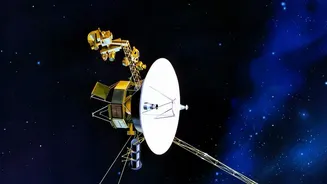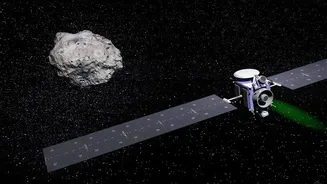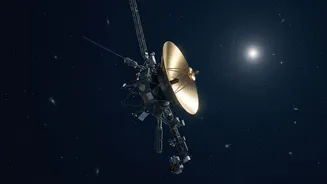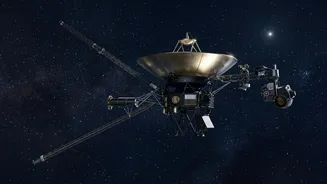

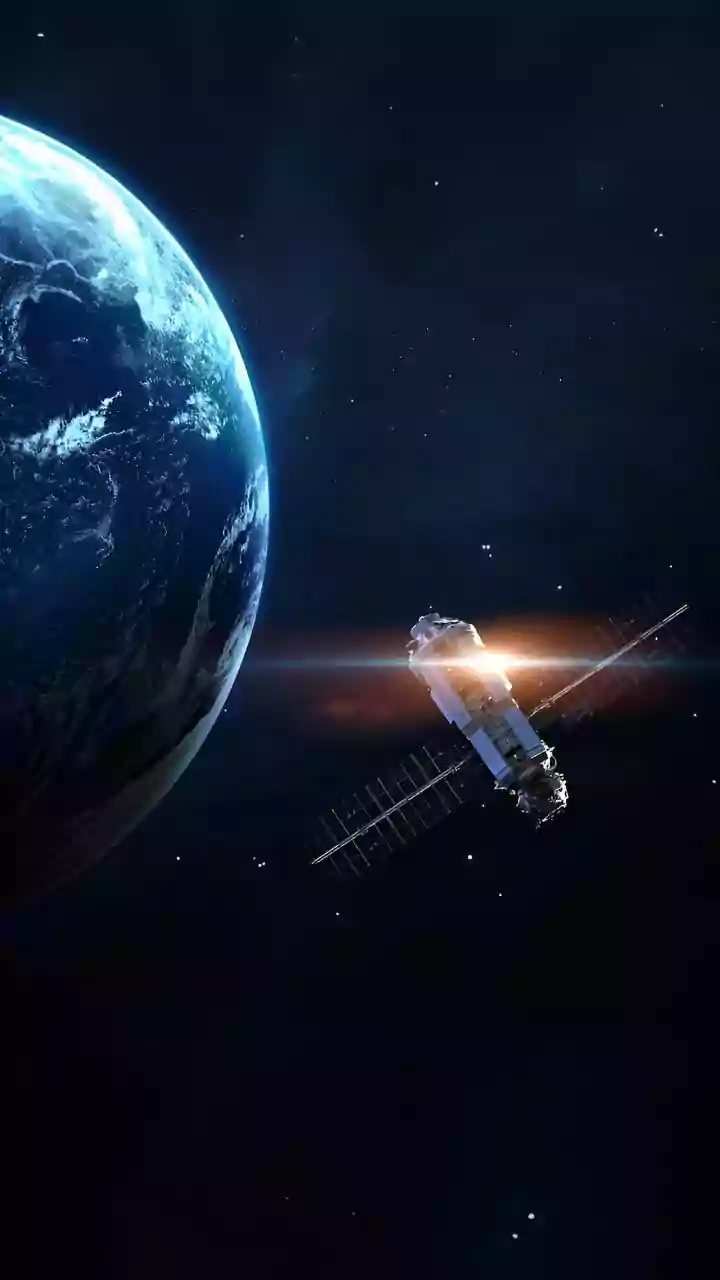
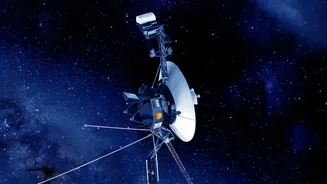
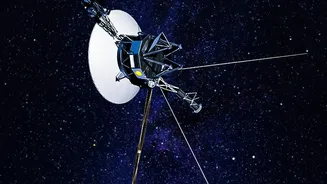
Launched when Star Wars was new and disco was alive, a machine from the 1970s is about to hit a staggering milestone. NASA's Voyager 1, humanity’s farthest emissary, is approaching a distance of one light-day from Earth.
A Journey Beyond Comprehension
On November 18, 2026, after travelling
for nearly 50 years, Voyager 1 will be one light-day away. What does that mean? A light-day is the distance light travels in 24 hours — a staggering 25.9 billion kilometres. To put that in perspective, a radio signal sent from NASA's Deep Space Network, travelling at the speed of light, will take a full day to reach the spacecraft. A simple round-trip communication, asking a question and getting a reply, now takes 48 hours. It’s a distance so vast that it underscores the incredible challenge of operating a mission that has journeyed from our cosmic neighbourhood into interstellar space.
The Grand Tour’s Enduring Legacy
Voyager 1 and its twin, Voyager 2, were launched in 1977 on a 'grand tour' of the outer solar system. Their original mission was to study Jupiter and Saturn. Voyager 1 revolutionized our understanding of these gas giants, discovering Jupiter's faint rings, active volcanoes on its moon Io, and several new moons at Saturn. After its Saturn flyby in 1980, a gravitational slingshot sent it hurtling out of the plane of the solar system at nearly 61,000 km/h. In August 2012, it made history by crossing the heliopause, the boundary where the Sun's influence ends, becoming the first human-made object to enter interstellar space.
An Engineering Miracle in Deep Space
Keeping a half-century-old spacecraft alive is a monumental task. Voyager 1 runs on dwindling power from its radioisotope thermoelectric generators, which convert heat from decaying plutonium into electricity, losing about four watts of power each year. Engineers have become masters of remote energy conservation, strategically shutting down instruments to prolong the mission's life. The craft has also overcome recent scares. A major computer glitch in late 2023 was miraculously fixed by engineers who had to diagnose the problem by consulting decades-old documents and waiting 45 hours for each command and response. More recently, in October 2026, the probe fell silent for 48 hours before unexpectedly resuming communication on its own.
Humanity's Golden Record
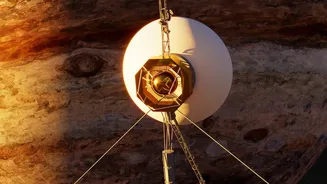
Attached to Voyager $1 is a message in a bottle on a cosmic scale: the Golden Record. This $12$-inch$, gold$-plated copper disc carries sounds and images selected to portray the diversity of life and culture on Earth. Assembled by a committee led by the late Carl Sagan, it contains $116$ images, greetings in $55$ languages, natural sounds like wind and surf, and $90$ minutes of music, from Bach to Chuck Berry's 'Johnny B. Goode'. It also includes a map showing our solar system's location relative to distant pulsars, in case an intelligent extraterrestrial civilization ever finds it. The record is a time capsule, a testament to a species that looked to the stars and sent a greeting.
The Long Goodbye
Though it has left the Sun's protective bubble, Voyager $1$ will not reach the inner edge of the Oort Cloud—a vast, icy shell of comets still bound to our sun—for another $300$ years. It will take an estimated $30,000$ years to pass through it completely. The probe's power will run out long before then. NASA scientists estimate its final instruments will be shut down in the $2030$s, and all communication with Earth will cease around $2036$. After that, Voyager $1$ will fall silent, continuing its journey alone through the Milky Way for eons. In about $40,000$ years, it will pass near a star called Gliese $445$, but its journey is, for all practical purposes, endless.