



The story of our universe is one of dramatic and persistent growth. But the term 'Big Bang' can be misleading. It wasn't an explosion in space, but an expansion of space itself. Understanding this is key to grasping our cosmic history.
Beyond the 'Explosion' Misconception
When we hear 'Big
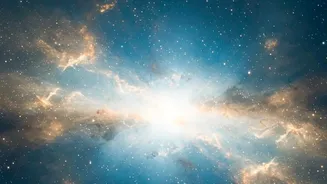
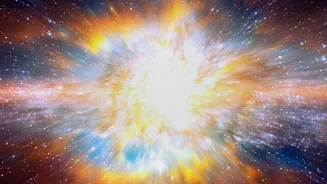
Bang', it’s easy to picture a cosmic firework exploding into a pre-existing void. However, this popular image is incorrect. The Big Bang theory describes the expansion of the entire universe from an extremely hot, dense state. It wasn't an event that happened at a single point in space; it happened everywhere at once because, at that moment, the entire observable universe was a single point. Think of it less like a bomb and more like the surface of a balloon inflating. As the balloon expands, every point on its surface moves away from every other point. Similarly, the Big Bang initiated the expansion of space-time itself, and this expansion continues today.
The First Clue: Redshifting Galaxies
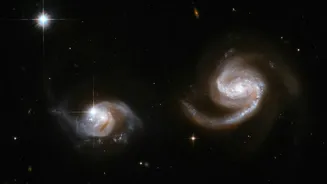
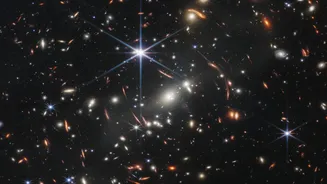
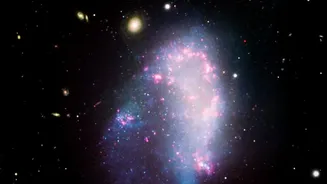
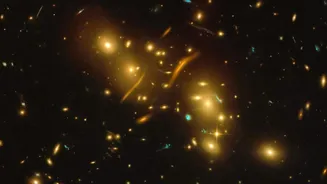
The first major piece of evidence for an expanding universe came in the 1920s. Astronomer Edwin Hubble (building on the work of others like Vesto Slipher and Georges Lemaître) observed that distant galaxies are moving away from us. He noticed that the light from these galaxies was 'redshifted'—meaning its wavelengths were stretched, similar to how the pitch of a siren lowers as it moves away from you. Crucially, Hubble found a clear relationship, now known as the Hubble-Lemaître law: the farther away a galaxy is, the faster it is receding from us. This observation is considered a cornerstone of the Big Bang model, providing the first observational proof that the universe was not static but in a state of dynamic expansion.
The Afterglow: Cosmic Microwave Background
If the universe began in a hot, dense state, there should be some leftover heat. This 'afterglow' was predicted in the 1940s and accidentally discovered in 1965 as a faint, uniform glow of microwave radiation across the entire sky. This is the Cosmic Microwave Background (CMB), and it is the oldest light in the universe, released about 380,000 years after the Big Bang. Before this time, the universe was an opaque fog of hot plasma. As it expanded and cooled, atoms formed, and the universe became transparent, allowing this ancient light to travel freely through space. The CMB is remarkably uniform, providing powerful evidence that the universe did indeed evolve from the hot, dense state the Big Bang theory describes.
A Surprising Twist: The Expansion is Accelerating
For much of the 20th century, cosmologists debated whether the expansion would slow down and eventually reverse due to gravity, leading to a 'Big Crunch'. However, in 1998, observations of distant supernovae revealed something astonishing: the expansion of the universe isn't slowing down; it's speeding up. This accelerated expansion is one of the biggest mysteries in science. The prevailing explanation is an unknown force or energy, dubbed 'dark energy', that acts as a sort of anti-gravity, pushing space-time apart. It's believed that for the first several billion years, gravity was the dominant force, slowing expansion. But as the universe grew, the influence of matter and gravity diluted, allowing dark energy to take over and drive acceleration.
Putting It All Together
The Big Bang Theory is not just about a single moment 13.8 billion years ago. It is the comprehensive framework that explains cosmic expansion itself. It accounts for the initial conditions, the creation of the first light elements, the redshift of distant galaxies, and the existence of the cosmic microwave background. The theory itself has evolved, incorporating new discoveries like an initial, faster-than-light 'inflationary' period and the current acceleration driven by dark energy. It provides a continuous narrative from a primordial state to the vast, accelerating universe we observe today, connecting our origins to our ultimate cosmic fate.