




An Ocean Reaching for Us
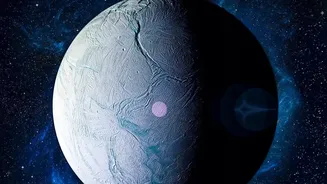
The quest to explore Enceladus has a unique advantage: the ocean is actively reaching out into space. In 2005, NASA’s Cassini spacecraft made a startling discovery: massive plumes of water vapour and ice particles erupting from deep fissures near the moon's
south pole. Analysis showed this spray contained not just water, but salts, silica, and simple organic molecules—all ingredients for life as we know it. These geysers, sourced directly from the subsurface ocean, offer a tantalizing opportunity. Instead of facing the monumental task of drilling through a thick ice shell, a spacecraft can simply fly through these plumes and catch a sample, a concept that has made Enceladus a top priority for space agencies like NASA and the European Space Agency (ESA).
Strategy One: The Plume Catcher
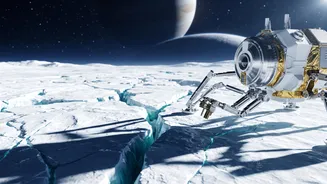
The leading near-term proposal is NASA's Enceladus Orbilander. As the name suggests, this single, versatile spacecraft is designed to perform two roles. First, it would spend about a year and a half orbiting Enceladus, making repeated passes through the plumes to collect icy particles. Then, it would execute a soft landing on the moon’s surface to analyze the plume material that has fallen back down like snow. The Orbilander would be equipped with a sophisticated suite of instruments to search for biosignatures, the chemical fingerprints of life. This includes mass spectrometers to identify complex organic compounds like amino acids and lipids, and high-resolution cameras to study the geology of the landing site. The mission, endorsed by the U.S. National Academies, could launch in the late 2030s and arrive at Saturn in the mid-2040s, with a potential landing in the early 2050s.
Strategy Two: Breaching the Ice
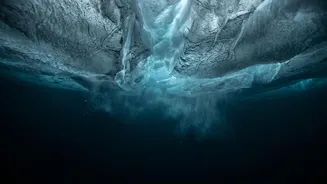
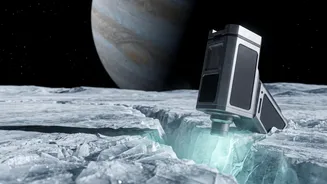
While sampling plumes is a brilliant shortcut, the ultimate goal is to explore the ocean directly. This requires conquering the moon's formidable ice shell, which is estimated to be 20 to 25 kilometres thick on average. Drilling mechanically through such a barrier in extreme cold, millions of kilometres from Earth, is not feasible with current technology. Instead, engineers are developing a far more elegant solution: a 'cryobot'. This is a dense, torpedo-shaped probe designed to melt its way through the ice. Powered by a nuclear heat source, such as the same radioisotope systems that have powered deep-space missions for decades, the cryobot would use its hot tip to melt the ice in front of it. Gravity would pull the heavy probe downward, while the melted water refreezes above it, sealing the tunnel as it descends.
Journey into the Alien Deep
The years-long descent of a cryobot would be a mission in itself, requiring it to navigate around debris and maintain communication with a lander on the surface, likely via a spooled fibre-optic cable. But the true science begins when it breaks through into the ocean below. Once submerged, the cryobot could act as a stationary science outpost or, more excitingly, deploy smaller, autonomous submarines. Concepts like the NASA-funded 'Sensing with Independent Micro-Swimmers' (SWIM) envision releasing a fleet of small, networked robots to explore the ocean. These 'hydrobots' would be equipped with their own sensors to measure temperature, salinity, and chemistry, and could even carry microscopes to search for microbial cells. Their primary mission would be to hunt for hydrothermal vents on the seafloor, which on Earth are teeming with life independent of sunlight.
A Two-Pronged Search for Life
The exploration of Enceladus is not a single mission but a generational strategy. The first phase, embodied by the Orbilander and a similar concept being developed by ESA, focuses on the 'low-hanging fruit' of the plumes. These missions could provide the first definitive evidence of biological processes on another world by analyzing ocean material without ever touching the liquid water. The second, more ambitious phase involves the cryobots and their submersible spawn. This represents a giant leap in robotic exploration, taking us directly into an alien marine environment. While the Orbilander could be sending back data by the 2050s, the technology to swim in Enceladus's ocean is still in development, pushing that timeline further into the future. Together, these complementary approaches represent humanity's best-ever chance to answer one of our oldest questions: are we alone?