




As dusk settles, a hidden world awakens. While we rely on sight, many bat species master the night using a remarkable biological sonar called echolocation, allowing them to 'see' the world through sound with astonishing precision.
Seeing with Sound
Echolocation is a fascinating
active sensing system used by about 70% of the world's over 1,400 bat species. Instead of relying on vision, these bats act like living sonar systems. They emit high-frequency sound pulses from their mouth or nose, which are often far beyond the range of human hearing. These sound waves travel outwards and bounce off everything in their path, from a towering tree to a tiny mosquito. The returning echoes are then collected by the bat's large, sensitive ears. By interpreting these echoes, the bat's brain constructs a detailed, three-dimensional 'sound map' of its surroundings, allowing it to navigate complex environments and hunt with incredible accuracy in complete darkness.
A Symphony of Clicks and Calls
The sounds bats produce are not random squeaks. They are highly sophisticated tools. Most echolocating bats generate these ultrasonic calls in their larynx, or voice box. Each call can vary in frequency, duration, and intensity depending on the bat's objective. For general navigation, a bat might emit regular 'search-phase' calls to scan its environment. But when a potential meal is detected, the bat rapidly increases the rate of its calls, creating a 'feeding buzz'. This rapid succession of clicks, sometimes up to 200 pulses per second, provides a continuous stream of information, allowing the bat to pinpoint the exact location, size, and even movement of its prey right up to the moment of capture.
Not All Echoes Are Equal
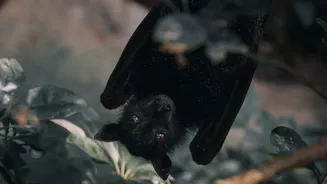
The world of bat echolocation is incredibly diverse. Traditionally, bats are divided into two groups: microbats and megabats. Most microbats are insect-eaters and are masters of laryngeal echolocation. In contrast, most megabats, often called fruit bats or 'flying foxes', typically rely on their excellent vision and sense of smell to find fruit and nectar, and do not echolocate. However, there are exceptions. The Leschenault's Rousette, a fruit bat found across the Indian subcontinent, can echolocate by clicking its tongue—a different mechanism from the laryngeal method used by microbats. Furthermore, different species have unique call patterns, with some known as 'shouting' bats that forage in open spaces, and others as 'whispering' bats that hunt in cluttered forests where a quieter approach is needed. In India, a rich diversity of echolocating bats exists, from the Greater False Vampire Bat to various species of horseshoe bats and mouse-tailed bats.
The Evolutionary Edge of Echolocation
The ability to echolocate has given bats a tremendous evolutionary advantage. It unlocked the night skies, allowing them to hunt the abundance of nocturnal insects with little competition. The precision of this sense is astounding; some bats can detect an object as fine as a single human hair. This biological sonar is so effective that it can distinguish not just an insect from a leaf, but even the texture and type of insect it is pursuing. However, this has led to an evolutionary arms race. Some prey, like certain species of moths, have evolved the ability to hear the bats' ultrasonic calls, allowing them to take evasive action. Some moths even have fuzzy wings that absorb sound to make them 'stealthy', while others can produce their own clicking sounds to jam the bat's sonar.