




The Echoes of a Grand Tour
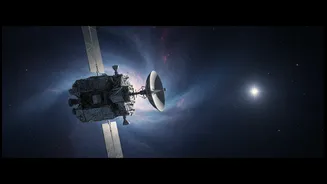
When we think of exploring the outer solar system, it’s hard not to feel a sense of nostalgia for NASA’s twin Voyager spacecraft. Launched in 1977, they were pioneers, giving humanity its first close-up views of Jupiter, Saturn, Uranus, and Neptune. Their
journey was a 'Grand Tour' that reshaped our understanding of the cosmos, discovering rings, moons, and volcanic activity on distant worlds. Now, nearly 50 years later, they are in interstellar space, the first human-made objects to leave the sun’s protective bubble, the heliosphere. They carry Golden Records, time capsules of our planet's sounds and images, for any civilization that might find them. But their power is fading. With many instruments shut down to conserve energy, their mission is winding down, their role shifting from active exploration to a legendary, slow fade into the cosmic ocean.
A New Explorer in the Outer Darkness
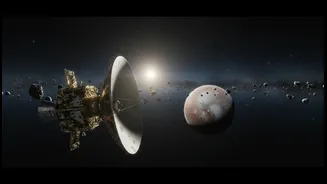
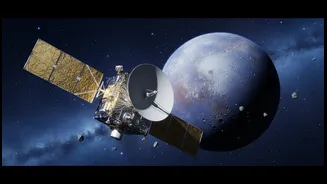
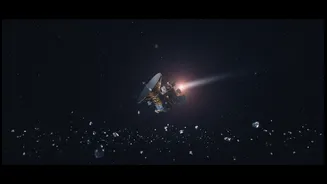
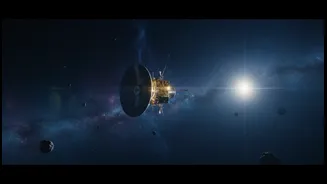
Launched in 2006, New Horizons is a different kind of explorer. It is faster, more focused, and equipped with a suite of sophisticated instruments that were the stuff of science fiction in the 1970s. Its primary mission was a breathtaking flyby of Pluto in 2015, revealing a complex world with ice mountains and a vast, heart-shaped glacier. Then, in 2019, it visited Arrokoth, the most distant and primitive object ever explored by a spacecraft. These encounters provided an unprecedented look at the building blocks of our solar system. Just this month, in early July 2026, the probe woke from a nearly year-long hibernation, healthy and ready to continue its work almost six billion miles from home. Its mission is far from over; in many ways, it's just beginning a new phase.
Science Beyond the Flyby
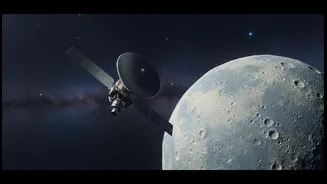
While the Voyager probes are now sampling the environment between the stars, New Horizons has a different job. Its mission was officially extended to continue exploring the Kuiper Belt—the vast doughnut-shaped ring of icy bodies beyond Neptune—until at least 2028. Its new focus is a blend of planetary science and heliophysics, studying the sun's influence at the edge of the solar system. From its unique vantage point, free from the dust and light that obscure views from Earth, it is measuring the solar wind, the plasma environment, and the dust density in a region no other modern spacecraft has visited. This isn't about repeating what Voyager did; it's about collecting higher-quality data from a region Voyager passed through with much older technology. The science is more targeted, answering specific questions about the structure of our solar system's 'third zone'.
The Hunt for a New Destination
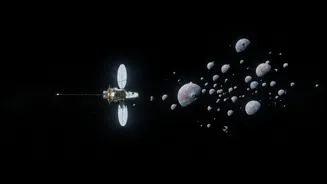
A key part of New Horizons' extended mission is the tantalizing possibility of another flyby. The team is actively searching for a second Kuiper Belt Object (KBO) that the spacecraft could reach with its remaining fuel. Finding such a target is incredibly challenging. It's like trying to spot a piece of coal in the dark from billions of miles away. Scientists are using powerful ground-based observatories and even artificial intelligence to scan a narrow strip of sky along the spacecraft's path. So far, a suitable candidate has not been found, but the search continues with the hope of using future instruments like the Vera C. Rubin Observatory. This active hunt demonstrates a key difference from the Voyager legacy: New Horizons is not just passively coasting. It remains a dynamic mission, capable of altering its course for one more close-up look at a primordial world.
Complementing a Legacy, Not Competing
Ultimately, the value of New Horizons isn't about diminishing the Voyager legacy but about building upon it. The Voyager probes provided the first, essential map of the outer solar system and interstellar space. New Horizons is now filling in the details of a critical part of that map—the Kuiper Belt—with a precision its predecessors couldn't match. While Voyager 1 reports on the magnetic fields and plasma far beyond the sun's influence, New Horizons uses its dust counter and spectrometers to hint that the Kuiper Belt might be far larger than previously thought. One mission gives us the context of interstellar space, while the other provides a high-resolution look at the solar system’s ancient frontier. It’s a powerful scientific partnership across time and distance, pushing past nostalgia to focus on the next discovery.