

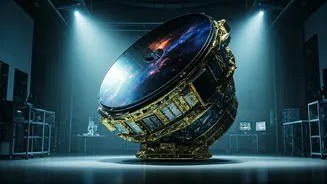
More Than a Successor to Hubble
When people hear “new space telescope,” many immediately think of a replacement for the Hubble or James Webb (JWST) telescopes. While the Nancy Grace Roman Space Telescope shares a lineage with these incredible observatories, it isn’t a successor—it’s
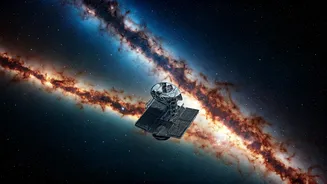
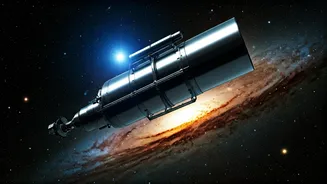
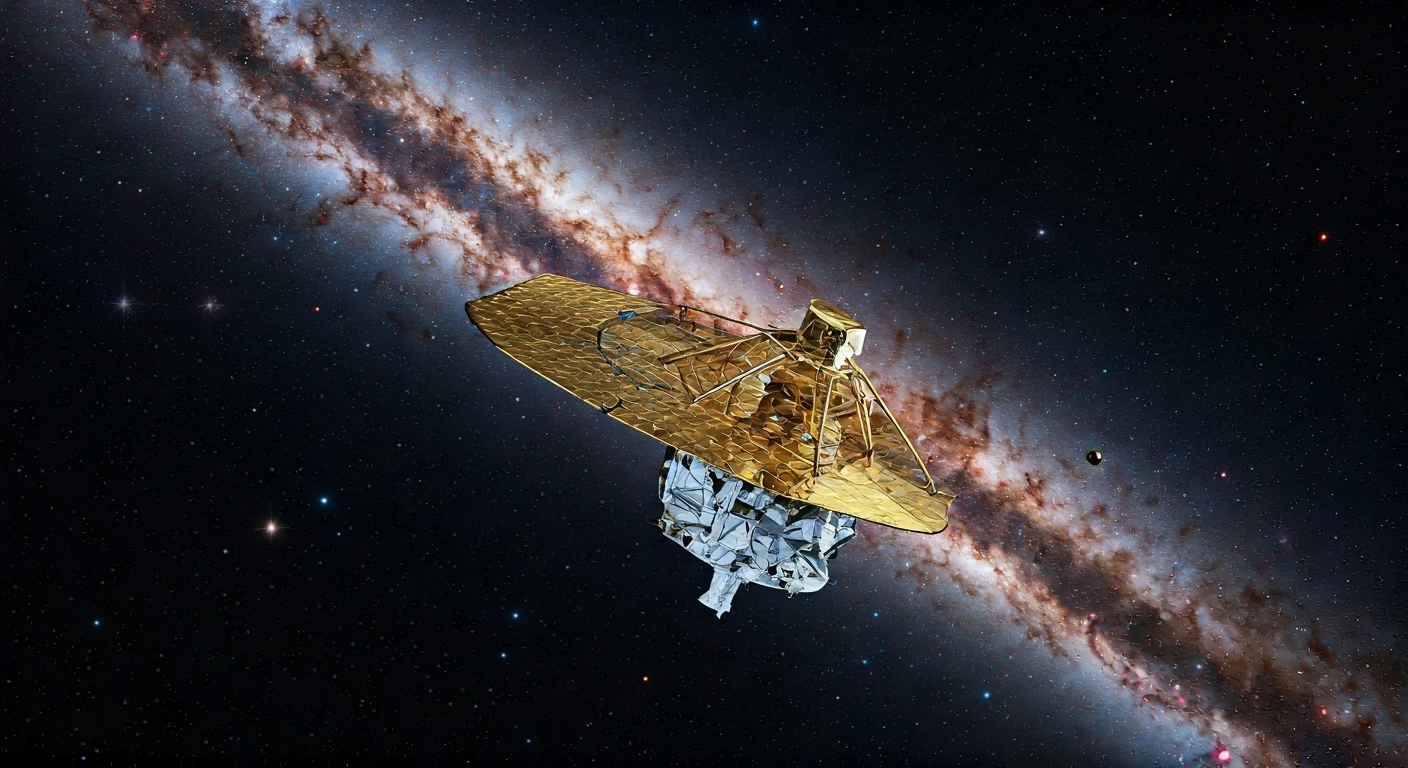
a completely different kind of tool designed for a new era of astronomy. Scheduled for launch around August 30, 2026, Roman’s primary mirror is the same size as Hubble's at 2.4 meters, but its power lies not in zooming in, but in zooming out. [1, 5] Its Wide Field Instrument (WFI) gives it a field of view 100 to 200 times larger than Hubble's infrared camera. [4, 15] Imagine trying to create a detailed map of a massive city by taking photos through a telephoto lens, one street corner at a time. That’s the traditional approach. Roman, by contrast, is like taking a high-resolution panoramic photo from a skyscraper, capturing entire districts in a single shot. This ability to survey vast swathes of the sky efficiently is what sets it apart. In its first five years, Roman is expected to image an area 50 times larger than Hubble has in over three decades of operation. [2]
A Big Data Revolution in the Cosmos
This wide-angle view isn’t just about making pretty pictures; it’s about generating an unprecedented volume of data. Roman is essentially a cosmic data factory. While Webb is a precision instrument for deep, focused observations of specific targets, Roman is a survey machine. [12, 13] It will create enormous, data-rich maps of the universe, providing context for the entire astronomical community. Its 300-megapixel camera, composed of 18 detectors, will generate vast datasets that scientists will mine for decades. [9, 12] This approach transforms astronomy from a hunt for individual objects into the analysis of massive populations of galaxies and stars. [11] The mission’s core surveys will map the distribution of galaxies, track thousands of exploding stars (supernovae), and monitor the heart of our own Milky Way galaxy. [18, 19] This firehose of information will fuel discoveries across all fields of astrophysics, making it a foundational resource for global science.
Hunting for Planets with a Cosmic Magnifying Glass
One of Roman's most exciting missions is its exoplanet census. Instead of just looking for planets by watching stars dim as a planet passes in front, Roman will heavily rely on a technique called gravitational microlensing. [1] This phenomenon, predicted by Einstein, occurs when a star and its planets pass in front of a more distant star. [6] The gravity of the foreground star acts like a magnifying glass, bending and amplifying the light of the background star. The presence of a planet around the foreground star causes a brief, additional spike in that light. [6] This method is exceptionally powerful for finding planets that are far from their star, free-floating rogue planets without a sun, and even very small, rocky worlds. [6, 11] By surveying the dense starfields at the center of our galaxy, Roman is expected to discover thousands of new exoplanets, creating a statistical map of planetary systems that will help us understand our own place in the cosmos. [9]
The Global Science Dividend
Perhaps the most significant aspect of Roman is its role as a global scientific asset. While NASA leads the mission, it includes international partners like the European Space Agency (ESA). [7, 22] More importantly, the data is for everyone. The mission includes a significant General Astrophysics program, allowing any scientist worldwide to propose observations or use its vast archive for their own research. [4] This open-data policy democratizes space science. It means a university team in Mumbai or a researcher in Bengaluru has the same access to this cutting-edge data as a scientist at a major NASA center. The telescope's instruments, like the Coronagraph—a technology demonstrator designed to block starlight to directly image planets—are intended to test technologies for future missions that will benefit the entire world. [6, 14] The discoveries made about dark energy and dark matter, which together are thought to make up 95% of the universe, won't just belong to NASA; they will rewrite textbooks everywhere. [2, 7]