
A Sizzling Paradox
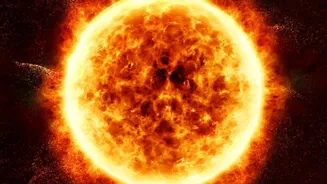
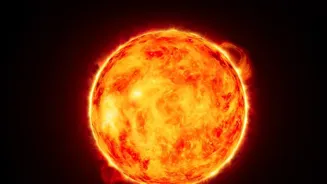
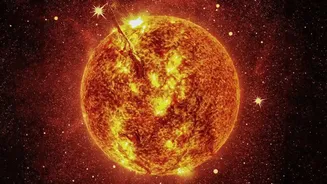
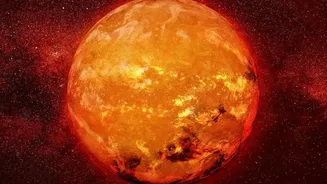
Imagine standing near a bonfire and feeling more heat the further you walk away. It doesn't make sense, but that's precisely the puzzle scientists face with the sun. The visible surface, or photosphere, clocks in at a blistering 5,600 degrees Celsius.
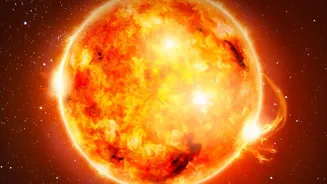
Logic dictates that temperatures should drop as you move away from this heat source. Yet, in the sun's wispy outer atmosphere, the corona, temperatures soar to a staggering 1 to 2 million degrees Celsius. This phenomenon, known as the coronal heating problem, has baffled astrophysicists since it was first identified in the 1930s. The laws of thermodynamics say heat shouldn't flow from a cooler object to a hotter one, so some other process must be transporting and depositing enormous amounts of energy into the corona.
The Prime Suspects: Waves and Flares
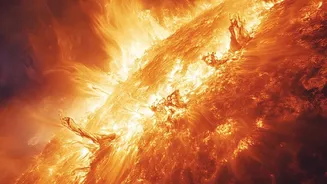
For decades, researchers have chased two main theories to explain this superheating. One idea involves magnetic reconnection, where tangled magnetic field lines suddenly snap and release energy in the form of countless tiny explosions called "nanoflares". The other leading theory proposes that energy is carried upward by waves rippling through the sun's plasma—the superheated, electrically charged gas that makes up the star. Of particular interest are Alfvén waves, which are magnetic waves that travel along field lines, much like a vibration travelling down a guitar string. These waves are thought to be generated by the churning, convective motions on the sun's surface, but proving they carry enough energy and can deposit it as heat in the right place has been a major challenge.
A New Twist in the Tale
The latest clue comes from the world's largest solar telescope, the Daniel K. Inouye Solar Telescope in Hawaii. Recent observations, published in August 2026, have captured the sun's surface in unprecedented detail, revealing structures as small as 20 kilometres across. Within this imagery, scientists identified swirling vortices of plasma at the edges of solar granules—the Texas-sized bubbling cells of gas that cover the sun's surface. These whirlpools are a classic sign of something called Kelvin-Helmholtz instability, which occurs when two fluids slide past each other at different speeds, creating a shear that curls into vortices. We see this effect everywhere, from winds creating waves on water to the distinct bands in Jupiter's atmosphere.
How Vortices Can Power the Corona
So, how do these tiny whirlpools on the surface help heat an atmosphere millions of kilometres away? The key is that these swirling motions twist and braid the magnetic field lines that extend from the surface high up into the corona. This process constantly pumps magnetic energy upwards. Think of it like repeatedly twisting a rubber band; you are storing energy in it. On the sun, these twisting motions generate a cascade of waves, including the suspected Alfvén waves, that travel up into the thin coronal plasma. The instability and turbulence created by these waves as they interact and break is a highly efficient way to convert the magnetic and kinetic energy from the surface into thermal energy, thereby heating the corona's sparse gas to its extreme temperatures.
Beyond the Heating Problem
Observing these plasma waves does more than just chip away at the coronal heating mystery. It also helps scientists better understand the origin of the solar wind, the continuous stream of charged particles that flows from the sun and throughout the solar system. The same mechanisms that heat the corona are believed to give the solar wind its initial push, accelerating it to supersonic speeds. A better grasp of these fundamental processes is crucial for improving our models of space weather. Violent solar events, like flares and coronal mass ejections, can hurl massive amounts of energy toward Earth, potentially disrupting satellites, power grids, and communication systems. By understanding the intricate dance of plasma and magnetic fields at the sun's surface, we get a clearer picture of the engine driving these powerful events.