



It’s Big, Bright, and Easy to Find
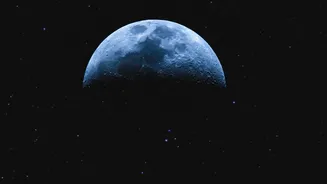
The most obvious advantage of the Moon is its sheer presence. As the brightest object in the night sky, you don’t need a sophisticated star chart or app to locate it. This accessibility removes one of the first major hurdles for beginners. Unlike faint
nebulae or distant galaxies that require dark skies and precise navigation, the Moon is a dependable and brilliant target. Its brightness means your camera's sensor can capture a strong signal without extremely long exposures, reducing the complexity of your first attempts. While a phone camera often struggles, turning the Moon into a blurry white dot, a basic DSLR or mirrorless camera can easily manage the light.
You Don’t Need Expensive Gear to Start
Astrophotography has a reputation for being an expensive hobby, but lunar photography is the exception that proves the rule. While professional astrophotographers use powerful telescopes, you can get surprisingly detailed shots with relatively modest equipment. A DSLR or mirrorless camera paired with a telephoto lens of at least 300mm is a great starting point. Many aspiring photographers already own a 70-300mm lens, which is perfectly capable of capturing impressive lunar images. You’ll also want a sturdy tripod to eliminate camera shake, but this is a fundamental piece of kit for any serious photography, not just for looking at the stars. An intervalometer or your camera's self-timer can also help you take pictures without physically touching the shutter, ensuring a sharper image.
A Masterclass in Manual Settings
Photographing the Moon is an excellent way to learn manual camera settings. Your camera's automatic mode will likely be fooled by the bright Moon against a dark sky, resulting in an overexposed, detail-less photo. To get it right, you'll need to take control. A good starting point is the 'Looney 11' rule: set your aperture to f/11, ISO to 100, and shutter speed to 1/100s. You can adjust from there. For instance, using a shutter speed of 1/125s or faster helps freeze the Moon’s motion and prevent blur, as it moves surprisingly quickly across the sky. Keeping the ISO low (100-200) ensures a clean, noise-free image. Experimenting with these settings to get a properly exposed, detailed grey surface is a fundamental skill that will serve you well in all types of photography.
An Ever-Changing Subject
The Moon is never boring. Throughout its 27-day cycle, it presents a different face each night. The changing phases mean you have an endless variety of shots to practice. Many beginners assume the full Moon is the best time to shoot, but that’s often not the case. When the Moon is full, the direct sunlight washes out many surface details. The most dramatic and detailed photographs are often captured along the 'terminator' — the line separating the light and dark sides of the Moon. Here, the low-angle sunlight creates long shadows, accentuating the texture of craters, mountains, and valleys. Shooting a crescent or gibbous moon will often yield more visually interesting and detailed results than a flat-looking full Moon.
A Gateway to the Wider Universe
Successfully photographing the Moon provides a huge confidence boost. It’s a tangible achievement that proves you can capture celestial objects. This initial success often becomes the spark for a lifelong passion. The skills you learn—manual exposure, focusing on a distant object, and post-processing to enhance detail—are directly transferable to more challenging deep-sky astrophotography. Learning to stack multiple images of the Moon to reduce noise and increase detail is a technique widely used for photographing planets, nebulae, and galaxies. The Moon is not just a subject; it’s a training ground that prepares you for capturing the rest of the magnificent universe.