




A Cosmic Neighbour Gets an Upgrade
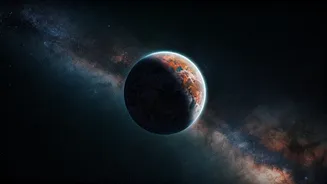
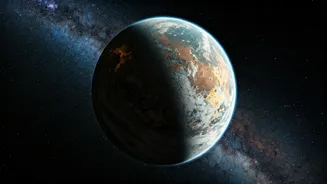
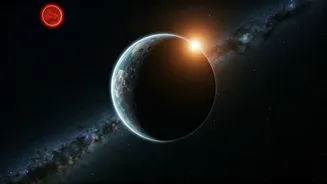
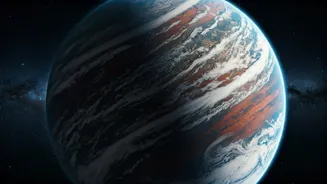
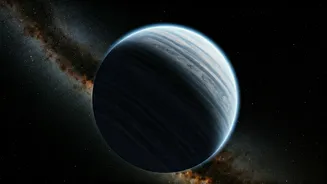
Just 25 light-years away, a not-so-small planet called GJ 3378b is orbiting a red dwarf star. In cosmic terms, that’s practically next door. When it was first discovered in 2024, scientists catalogued it as a "Super-Earth"—a rocky world larger than our
own, but not a gas giant. Initial estimates put its mass at about five times that of Earth. Interesting, but perhaps too large to be truly Earth-like. However, a new analysis published in The Astrophysical Journal has completely revised our understanding of this world. Updated measurements show its mass is much lower, around 2.3 times that of Earth, making it a much stronger candidate for a rocky world with a potentially thinner, more life-friendly atmosphere.
The 'Goldilocks' Sweet Spot
What makes the new findings about GJ 3378b so exciting is its location. The planet sits squarely within its star's habitable zone, often called the “Goldilocks zone.” This is the orbital region where it's not too hot and not too cold for liquid water to potentially exist on a planet's surface. The new data confirms GJ 3378b receives about 90% of the radiation from its star that Earth gets from the Sun, placing it in an ideal position. According to Paul Robertson, an astronomer at the University of California, Irvine, and the study's lead author, this puts the planet “right in the sweet spot.” The potential for liquid water is a critical first step in the search for life as we know it.
A Tale of Two Telescopes
This revised understanding of GJ 3378b wasn't a fluke. It was the result of combining the power of advanced astronomical tools. Researchers used data from the Habitable-zone Planet Finder instrument on the Hobby-Eberly Telescope in Texas and the NEID Spectrometer on the WIYN Telescope in Arizona. These sophisticated instruments allowed for a more precise measurement of the planet's gravitational pull on its star, which in turn provided the more accurate, and lower, mass estimate. This precision is crucial; without it, smaller, potentially habitable worlds like this one could be easily overlooked or miscategorized.
The Atmospheric Question Mark
Despite the optimism, a huge question remains: does GJ 3378b have an atmosphere? And if so, what kind? The planet's revised size is promising, as it increases the likelihood that it is rocky and not enveloped in a crushing, thick atmosphere. However, its proximity to its red dwarf star also places it near the “cosmic shoreline.” This is a theoretical boundary where intense solar radiation could strip a planet's atmosphere away over time, much like what is believed to have happened to Mars in our own solar system. Determining whether GJ 3378b has retained a stable atmosphere—a thin but protective blanket like Earth's—is the next critical step.
What Happens Next?
For now, scientists can’t confirm the presence of an atmosphere on GJ 3378b. Current telescopes have pushed their limits to give us this new data. Answering the atmospheric question, and ultimately searching for biosignatures—chemical signs of life—will require the next generation of observatories. NASA’s planned Habitable Worlds Observatory, slated for a launch sometime in the 2040s, is being designed specifically to image planets like GJ 3378b and analyze their atmospheres. While that may seem like a long wait, this discovery provides a tantalizing and specific target for these future missions, sharpening the focus of our search for life beyond Earth.