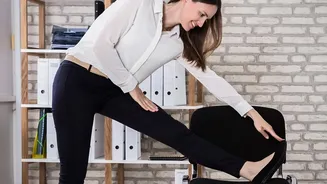








That nagging ache in your neck, the stiffness in your back after a long day—sound familiar? For millions with desk jobs, sedentary routines are a major source of joint discomfort. Here’s a closer look at why it happens and how to fix it.
Why Sitting Causes Stiffness
The human body
is designed for movement. When you sit for extended periods, several things happen that contribute to joint pain. Firstly, the circulation of synovial fluid, your joints' natural lubricant, slows down. This fluid is essential for keeping cartilage healthy and allowing bones to glide smoothly. Without regular movement to refresh this fluid, joints can feel stiff and achy. Secondly, prolonged sitting leads to muscle imbalances. Muscles like your hip flexors and hamstrings become tight and shortened, while others, like your glutes and core, become weak from inactivity. This imbalance places extra strain on your joints, particularly in the lower back, hips, and knees.
Common Trouble Spots for Desk Workers
While discomfort can arise anywhere, desk work typically strains a few key areas. The neck and shoulders often suffer from 'forward head posture', where your head drifts towards the screen, straining the supporting muscles. The lower back is another major concern, as slouching in a chair without proper support increases pressure on your spinal discs. The hips can become tight and lose mobility from being in a flexed position for hours. Finally, the wrists and hands are at risk for repetitive strain injuries like carpal tunnel syndrome from constant typing and mouse use with poor alignment.
Ergonomics: Your First Line of Defence
You can significantly reduce joint strain by optimising your workstation. The goal is to create a setup that supports a neutral posture. Start with your chair: adjust it so your feet are flat on the floor and your knees are at roughly a 90-degree angle. Your hips should be level with or slightly above your knees. Position your monitor so the top of the screen is at or just below eye level, about an arm's length away, to keep your neck straight. Your keyboard and mouse should be close enough that your elbows can stay bent at a 90-degree angle, with your wrists straight and forearms parallel to the floor. Using a separate keyboard and mouse with a laptop is a highly effective change.
Simple Mobility Moves at Your Desk
Frequent, small movements are more effective than one long stretch session. Aim to get up and move every 30 to 60 minutes. Even at your desk, you can perform simple exercises to relieve tension. For your neck, gently tilt your head from side to side, holding for 15 seconds each way. Relieve shoulder stiffness with shoulder rolls or by squeezing your shoulder blades together. For your spine, try a seated torso twist: gently rotate to one side, holding the back of your chair for support, then repeat on the other side. To open up tight hips, try a seated figure-four stretch by crossing one ankle over the opposite knee and gently leaning forward.
Stretches for Wrists and Legs
Don't forget your extremities. To combat typing strain, extend one arm with your palm up and gently pull your fingers back with the other hand to stretch your forearm; hold for 15–20 seconds and repeat on the other side. You can also do this with the palm facing down. For your legs, simple leg extensions while seated can help. Sit tall and extend one leg straight out in front of you, hold for a few seconds, and lower it. Repeat about ten times for each leg to keep the muscles around your knees active. Taking a moment to stand and stretch your calves against a wall can also relieve tightness in the lower legs.
Beyond the Desk: A Holistic Approach
While desk–side adjustments are crucial, your habits outside of work hours also play a significant role in joint health. Incorporating regular physical activity, such as walking, swimming, or yoga, helps strengthen the muscles that support your joints and improves overall mobility. Staying hydrated is also important, as it helps maintain the fluid in your joints. Pay attention to your posture even when you're not working, like when you're using your phone or watching TV. A strong core, healthy diet, and sufficient sleep all contribute to your body's ability to handle the stresses of a sedentary job.