


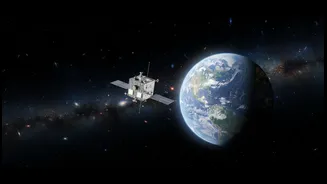


Meet the Trailblazing CubeSat
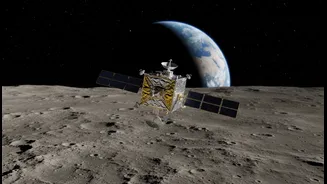
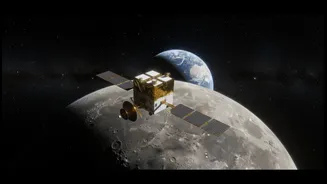
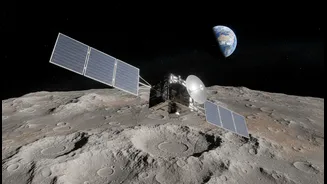
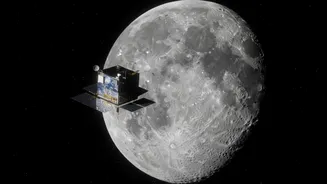
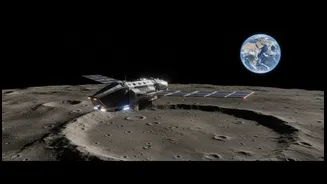
CAPSTONE, short for the Cislunar Autonomous Positioning System Technology Operations and Navigation Experiment, is a microwave oven-sized spacecraft with a giant mission. Launched in June 2022, it was designed as a pathfinder for NASA's Artemis program,
which aims to establish a sustained human presence on and around the Moon. Owned and operated by the commercial company Advanced Space, CAPSTONE has already achieved its primary goals, but continues to serve as a crucial testbed in lunar orbit. Its main purpose was twofold: to be the very first spacecraft to enter and validate a unique lunar orbit, and to test a groundbreaking autonomous navigation system.
A New and Unusual Path Around the Moon
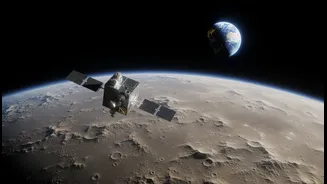
At the heart of CAPSTONE's mission is the Near-Rectilinear Halo Orbit, or NRHO. Unlike the relatively simple circular orbits we're used to seeing, the NRHO is a highly elliptical, three-dimensional path that is carefully balanced between the gravitational pulls of the Earth and the Moon. A spacecraft in this orbit makes a close pass over one lunar pole before swinging out tens of thousands of kilometers over the other pole. This specific orbit was chosen for the future Lunar Gateway, a planned orbiting outpost, because it is remarkably stable and requires very little fuel for a long-term mission to maintain its position. Before committing a massive project like the Gateway, NASA needed to prove this orbit was as stable and reliable as models predicted, a job CAPSTONE successfully completed.
A GPS for Deep Space
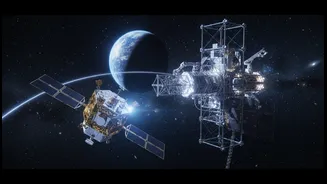
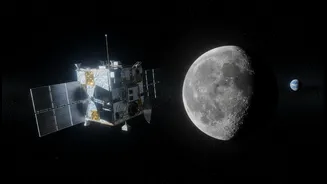
The second, and perhaps more revolutionary, part of CAPSTONE's mission is demonstrating the Cislunar Autonomous Positioning System (CAPS). Traditionally, spacecraft in deep space rely on constant communication with giant antennas on Earth, part of the Deep Space Network, to know exactly where they are. This process is effective but also time-consuming and expensive, creating a bottleneck as more missions head to the Moon. CAPS offers a new way: peer-to-peer navigation. The CAPSTONE spacecraft communicates directly with another satellite—in this case, NASA's Lunar Reconnaissance Orbiter (LRO)—sending signals back and forth. By measuring the time it takes for these signals to travel, the onboard software can calculate its own position relative to LRO, essentially creating its own navigation fix in deep space without phoning home to Earth.
Why Autonomous Navigation Is a Game-Changer
The implications of a successful CAPS demonstration are enormous. For engineers and mission planners, it represents a fundamental shift from reliance on Earth to true autonomy in space. This technology could dramatically reduce operational costs and free up the Deep Space Network to handle more critical scientific data instead of routine tracking. For future missions, it means increased safety and flexibility; a spacecraft that knows its own position can react to situations faster without waiting for commands from ground control. This is essential for building a bustling cislunar economy, where dozens of commercial and government spacecraft might be operating around the Moon simultaneously. An autonomous navigation network would be the celestial equivalent of an air traffic control system, preventing collisions and ensuring smooth operations.
The Legacy of a Pathfinder
Though NASA officially concluded its primary technology demonstrations with CAPSTONE in June 2026, the mission's impact is just beginning. The spacecraft, still operational under the control of Advanced Space, proved that a small, relatively low-cost CubeSat could perform critical pathfinding work for major exploration programs. It validated the orbit that will serve as a staging ground for future Artemis astronauts and tested the software that could become the navigational backbone for all lunar activity. CAPSTONE successfully showed that future spacecraft can be more self-reliant, a necessary step for enabling a permanent human and robotic presence on the Moon and, eventually, for missions to Mars and beyond.