


The First Glance: What Meets the Eye
The initial investigation starts with simple visual clues. Many freshly fallen meteorites have a distinct feature called a fusion crust. This is a thin, dark, glassy or eggshell-like coating that forms when the rock’s outer surface melts during its fiery
descent through Earth's atmosphere. This crust is often black but can weather to a rusty brown over time. The rock’s shape is another clue. Meteorites are often irregularly shaped but can have smooth surfaces with shallow, thumbprint-like depressions called regmaglypts, formed by the airflow during entry. What they almost never have are bubbles or vesicles; those are tell-tale signs of volcanic rock or industrial slag, a common “meteorwrong.”
Simple Field Tests: Weight and Magnetism
Two easy field tests can quickly narrow down the possibilities. First is density. Meteorites are often much heavier for their size than typical Earth rocks because they contain dense iron-nickel metal. An iron meteorite can be over three times as dense as a similar-sized terrestrial rock. The second test is magnetism. Because of their iron content, most meteorites will attract a magnet. Even stony meteorites, which look more like regular rocks, usually contain enough small, shiny flecks of metal to weakly attract a magnet. However, these tests aren't definitive. Some Earth minerals like magnetite and hematite are also dense and magnetic, and industrial byproducts like slag can mimic these properties, making them frequent sources of confusion.
The Modern Twist: Is It Space Debris?
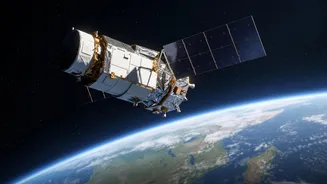
In the 21st century, not everything that falls from the sky is natural. With thousands of satellites in orbit, re-entering space debris is an increasingly common phenomenon. While a meteor streaks across the sky in a few seconds, re-entering debris often moves more slowly, appearing like a slow-moving aircraft and potentially lasting for a minute or more as it breaks apart. If a piece is recovered, its composition is the biggest giveaway. Space junk is made of human-engineered materials like stainless steel, titanium alloys, and carbon fibre, which are not found in meteorites. While both natural and artificial objects heat up on re-entry, the materials tell a different story. Scientists can even detect specific vaporised elements like lithium in the upper atmosphere, linking them directly to a specific rocket’s re-entry.
Inside the Lab: The Definitive Answer
To be certain, scientists must take a look inside. Cutting open a suspected meteorite can reveal unmistakable evidence. Many stony meteorites contain tiny, spherical grains called chondrules, which are primordial droplets that formed in the early solar system. These are not found in Earth rocks. If the sample is an iron meteorite, cutting, polishing, and etching it with a weak acid can reveal a stunning, crisscrossing metallic pattern known as a Widmanstätten pattern. This intricate crystal structure is formed as the iron-nickel alloy cools over millions of years inside an asteroid—a process impossible to replicate on Earth. Its presence is definitive proof of a meteorite origin.
The Chemical Fingerprint
The final, irrefutable evidence comes from chemical analysis. Meteorites have a distinct chemical makeup compared to both Earth rocks and man-made debris. A key indicator is the presence of nickel alongside iron, an alloy common in meteorites but rare in man-made iron objects. Furthermore, the ratios of different elements can be a dead giveaway. For example, meteorites do not contain quartz, so a rock with high silica content is almost certainly terrestrial. Scientists also look for specific organic compounds. Recent studies on meteorites, such as the one that landed in New Jersey in 2024, have found hundreds of different amino acids, many of which are not naturally found on Earth, providing clues to the chemistry of the early solar system.