



What the New Model Predicts
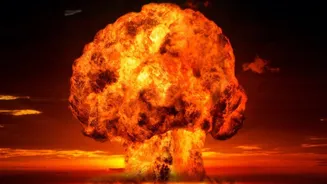
A recent study, not yet peer-reviewed, paints a stark picture of orbital vulnerability. Researchers from the University of Wisconsin-Madison and Princeton University modelled a hypothetical 1-megaton nuclear detonation at an altitude of 500 kilometres.
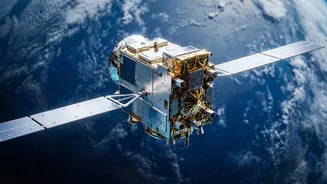
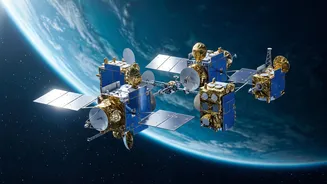
The results are catastrophic. According to their simulation of over 13,000 active satellites in low Earth orbit (LEO), approximately 98% of the fleet would be disabled within a single week. The losses would be rapid: 25% after one day, climbing to 78% after three days, before reaching near-total incapacitation. The study highlights that even satellites with triple the standard radiation shielding would not be spared; 97% of these 'hardened' craft would still fail within two weeks.
The Invisible Killer: An Artificial Radiation Belt
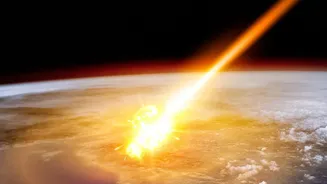
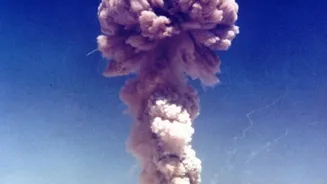
Contrary to what one might imagine, the immediate blast of a space-based nuclear weapon isn't the primary threat to satellites. The initial X-ray flash would disable only about 3% of the LEO constellation. The far greater danger comes from what is left behind. The detonation releases a massive cloud of energetic electrons from radioactive fission products. These particles become trapped by Earth's magnetic field, forming a dense, artificial radiation belt that lingers in space for years. Satellites orbiting the Earth repeatedly pass through this invisible hazard, and with each pass, their sensitive electronics absorb a cumulative dose of radiation, leading to inevitable failure. This phenomenon is not just theoretical; the 1962 'Starfish Prime' test, a 1.4-megaton U.S. detonation at 400 km, created a similar belt that damaged or destroyed about a third of the few dozen satellites in orbit at the time.
Life on Earth After the Lights Go Out
The loss of nearly all LEO satellites would not cause an immediate societal collapse, but it would trigger a 'prolonged degradation' of services we take for granted. Global positioning systems (GPS), crucial for everything from ride-hailing apps and food delivery to commercial aviation and shipping logistics, would cease to function. Many financial transactions, which rely on satellite networks for timing and synchronisation, could fail. Global communications and internet services, increasingly reliant on LEO constellations like Starlink, would be severely disrupted. Weather forecasting, disaster monitoring, and scientific research would all be crippled. For India, this would mean a sudden and severe blow to its digital economy, logistics, and emergency response capabilities.
A New Front in Geopolitical Tensions
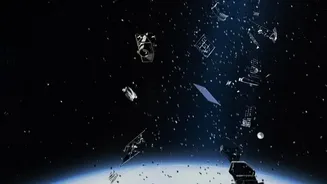
This scientific modelling arrives at a time of growing concern over the weaponisation of space. In recent years, U.S. officials have warned that Russia is developing a nuclear anti-satellite capability. The 1967 Outer Space Treaty expressly forbids placing nuclear weapons in orbit, but the strategic value of space as a military domain has made it a new arena for great power competition. A space-based nuclear weapon is seen as a way to indiscriminately neutralise an adversary's critical military and civilian infrastructure without causing direct casualties on the ground, a scenario that some strategists fear could lower the threshold for its use. The resulting loss of maneuverability for thousands of satellites would also dramatically increase the risk of orbital collisions, with the model predicting around 20 collisions in the first two years, creating a cascade of dangerous space debris that would make launching replacements incredibly hazardous.