





A Celestial Dance in the Dawn
Early risers are in for a special treat on Tuesday, October 6, 2026. In the hours before sunrise, a beautiful, thin crescent Moon will appear strikingly close to the planet Jupiter. This event, known as a conjunction, happens when two celestial bodies
appear to pass near each other in the sky from our viewpoint on Earth. Although they are actually millions of kilometres apart, this alignment creates a captivating visual spectacle that is easy to spot. For many observers around the world, the Moon will actually pass in front of Jupiter in an event called an occultation. While the full occultation might not be visible from all parts of India, the incredibly close pairing will be a sight to behold everywhere.
When and Where to Look
The key to catching this event is to get up before the sun on October 6. The best time to look will be in the pre-dawn hours. You’ll want to find a viewing spot with a clear view of the eastern horizon, away from tall buildings or trees if possible. Look towards the east, and you won't be able to miss it. Jupiter will shine as a brilliant, steady 'star', and the slender crescent of the Moon will be right beside it. The pair will rise together and climb higher into the southeastern sky as dawn approaches, making for a truly beautiful morning sight.
No Telescope Needed
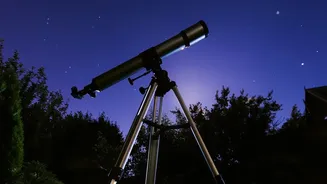
One of the best things about this celestial event is its accessibility. You don’t need any special equipment to enjoy the show; the Moon and Jupiter are so bright that their pairing will be easily visible to the naked eye. This makes it a perfect activity for families and anyone curious about the night sky. Simply step outside, let your eyes adjust to the darkness for a few minutes, and enjoy the view. If you do have a pair of binoculars, however, you're in for an even bigger treat. Binoculars will not only give you a closer look at the craters on the Moon but may also reveal Jupiter’s four largest moons — Io, Europa, Ganymede, and Callisto — appearing as tiny pinpricks of light lined up next to the giant planet.
The King of Planets
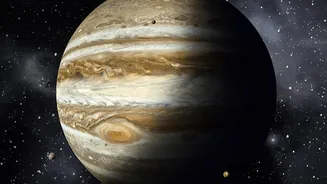
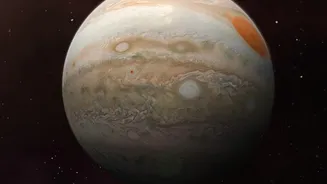
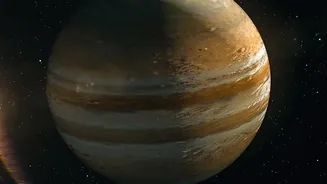
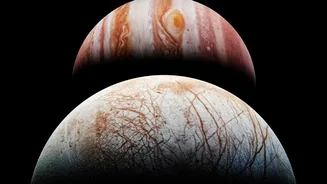
The bright 'star' meeting the Moon is none other than Jupiter, the largest planet in our solar system. Its immense size and thick, reflective cloud tops make it one of the brightest objects in our night sky, outshone only by the Moon and Venus. Jupiter has fascinated astronomers for centuries and continues to be a subject of intense scientific study. Occultations, like the one happening on October 6, were historically important for scientists to learn about Jupiter's size, orbit, and its powerful magnetic field. While we now have spacecraft to study it up close, watching it from our own backyards is a powerful reminder of the grand scale of our cosmic neighbourhood.
A Month of Sky-High Events
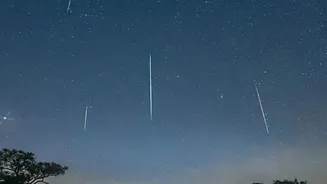
This Moon-Jupiter pairing is part of a busy month for skywatchers in India. Just the morning before, on October 5, the crescent Moon will have a close encounter with the planet Mars. Later in the month, look out for the Draconid meteor shower (peaking October 8-9) and the Orionid meteor shower (peaking October 21-22). October also offers a great chance to see Saturn, which reaches opposition on October 4, making it visible all night long and at its brightest for the year. These events provide a wonderful opportunity to connect with the night sky throughout the month.