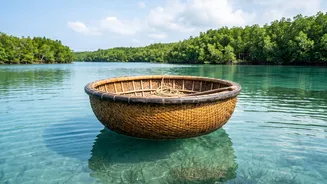






At first glance, they look like giant woven bowls scattered across the water. But the iconic round vessels of coastal Vietnam, known as 'thung chai' or basket boats, are far more than a visual curiosity. They are symbols of resilience.
A Floating Mosaic at Dawn
Picture a harbour
in Mui Ne or Hoi An as the sun rises. The shoreline is a hive of activity, with fishermen returning with their overnight catch. Larger wooden boats anchor further out, but the real magic happens closer to shore. Dozens, sometimes hundreds, of round basket boats bob on the gentle waves, ferrying people and seafood between the main vessels and the bustling markets on land. These boats, with their distinctive shape and the rhythmic motion of a single oar, are an essential part of the daily life and visual identity of Vietnam’s central and southern coasts. They are not just tools; they are the heart of the harbour.
A Clever Colonial-Era Legend
The most popular story behind the basket boat's unique circular shape is a tale of shrewd ingenuity. It is widely believed that their design became popular during the French colonial period. When the French administration imposed a tax on the ownership of boats, it placed a heavy burden on poor fishing communities. To avoid this fee, fishermen created a vessel that they could argue was not a boat at all, but simply a large basket. As the story goes, the ploy worked. The 'thung chai' was deemed a basket, and therefore exempt from the tax, allowing fishermen to continue their livelihood. This origin story highlights a spirit of creative resistance that adds to the boat's cultural charm.
Woven from Nature and Skill
Creating a traditional basket boat is a testament to meticulous craftsmanship. Artisans start by selecting young, flexible bamboo, which is then split into thin strips. These strips are expertly woven into a tight, bowl-shaped frame. To make it waterproof, the hull is sealed, traditionally with a mixture of resin from local trees, like the 'cai son' tree, and sometimes cow dung. Modern versions might use fibreglass or other composite materials, but the fundamental design and the skill required have been passed down through generations. A well-made and maintained bamboo boat can last for decades, becoming a trusted companion to its owner.
The Fisherman's Right Arm
Despite its simple appearance, the basket boat is an incredibly versatile and effective tool for fishermen. It's often called the 'right arm' of the fisherman. Its lightweight nature means it can be carried easily, and its round shape makes it remarkably stable in choppy surf, bobbing on top of waves that might trouble a different kind of vessel. Fishermen use them for a variety of tasks: laying and retrieving nets near the shore, fishing for octopus and cuttlefish, and transporting their catch from larger ships. Propelling the boat requires a unique sculling technique, a figure-eight motion with a single oar that takes practice to master but is incredibly efficient once learned.
From Fishing Utility to Tourist Favourite
In recent years, the role of the basket boat has evolved significantly. While still a vital tool for fishing, it has also become a major tourist attraction, particularly in places like Hoi An's Bay Mau Coconut Forest. Here, visitors can take guided tours through serene, palm-fringed waterways, often accompanied by boat-spinning performances and traditional folk songs from the rowers. These eco-tours provide a new stream of income for local communities and offer travellers a fun, immersive way to experience a piece of Vietnamese culture firsthand. This transition from a purely functional vessel to a cultural experience has cemented the basket boat's status as an enduring symbol of coastal Vietnam.