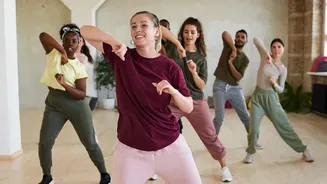







The Calorie Conundrum
When it comes to pure calorie burn, running often has the edge. A steady run typically burns more calories per minute than most forms of social or moderate-intensity dancing. For example, 30 minutes of running at a moderate pace can burn around 345 calories,
while general dancing might burn closer to 193 calories in the same amount of time. However, this isn't the full story. The intensity is what truly matters. High-intensity dance styles like street dance or vigorous Zumba can rival or even exceed the calorie burn of a steady run. Some studies have found that certain dance classes can burn over 300 calories in 30 minutes, out-pacing running and cycling. Ultimately, a high-energy dance session will be far more effective than a slow jog. The key is the effort you put in.
Muscle, Tone, and Impact
Running is a forward-motion, high-impact activity that primarily strengthens the lower body. It builds powerful leg muscles and is excellent for cardiovascular endurance. Dancing, on the other hand, is a full-body workout. It involves lateral, rotational, and vertical movements that engage your core, arms, back, and legs simultaneously. This variety helps develop muscle groups that running often misses, improving overall coordination, balance, and flexibility. Because running involves repetitive impact, it can be tough on joints like the knees and ankles. Most dance forms are considered lower-impact, spreading the stress across different movements and reducing the risk of repetitive strain injuries.
The Mental and Emotional Edge
Both activities are fantastic for mental health, releasing mood-boosting chemicals like endorphins. Runners often speak of the 'runner's high', a state of euphoria and mental clarity. However, research suggests dancing may have a unique psychological advantage. Studies have shown that structured dance can be as effective, and sometimes more so, than other exercises at improving emotional well-being, reducing anxiety and depression, and boosting self-confidence. The combination of music, self-expression, social connection, and the mental challenge of learning choreography provides a powerful cocktail for the brain. While running can be meditative, dancing is often a more joyful and socially engaging experience, which can be a huge motivator.
Individual Variation and Body Type
This is where personal preference and body mechanics become critical. Your natural build can influence which activity feels better and yields better results. For example, individuals with a naturally long, lean frame (ectomorphs) often excel at endurance activities like running. Those who build muscle easily (mesomorphs) might enjoy the power and strength demands of both, while those who gain weight more easily (endomorphs) may benefit from the high-calorie burn of either activity, depending on which they enjoy more. But these are just generalities. Factors like pre-existing injuries, coordination, and rhythm also play a significant role. If you have joint issues, the lower-impact nature of dance might be a safer choice. If you love solitude and clear goals, running might be your calling.
The Deciding Factor: Consistency
The most effective exercise is the one you do consistently. The debate over whether running or dancing is 'better' for weight loss is secondary to which activity you will actually stick with. If you dread the thought of pounding the pavement but love moving to music, a dance class will give you far better long-term results than a running program you abandon after two weeks. Enjoyment is a powerful driver of habit. The fun factor in dancing often makes it feel less like a chore and more like a hobby, encouraging regular participation. For others, the simplicity and goal-oriented nature of running is what keeps them motivated. The best approach is to choose the activity that brings you the most joy, as that is the one you are most likely to make a permanent part of your life.