



The Atmosphere's Blind Spots
For decades, scientists have built increasingly sophisticated computer models to predict weather and project long-term climate change. These models simulate everything from ocean currents to greenhouse gas effects. However, they have historically struggled
to account for sudden, massive injections of particles and gases from events like megafires and powerful volcanic eruptions. These phenomena act as wild cards, introducing huge variables that current models are not always equipped to handle. The sheer scale and increasing frequency of these events mean that what were once considered rare outliers are now becoming crucial factors in understanding our atmosphere. Getting them right is essential for accurate forecasting.
Smoke Signals and Volcanic Veils
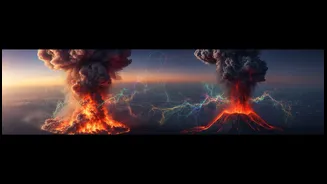
The key players are aerosols—tiny particles of smoke, ash, and chemicals suspended in the air. When a volcano erupts, it can spew millions of tons of sulfur dioxide into the stratosphere, the atmospheric layer above where our weather occurs. This gas converts into sulfate aerosols that act like a planetary sunshade, reflecting sunlight and causing a temporary cooling of the Earth's surface. Wildfire smoke, composed of black carbon and other organic compounds, behaves differently. These dark particles are highly effective at absorbing sunlight, which can warm the stratosphere while cooling the surface below. For months, or even years, these aerosol layers can linger, subtly altering temperature gradients, circulation patterns, and even the paths of storms across the globe.
When Fire Makes Its Own Weather
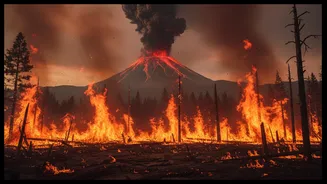
Modern wildfires are becoming so intense that they generate their own weather systems. Towering, fire-driven thunderstorms, known as pyrocumulonimbus (pyroCb) clouds, act like volcanic eruptions, punching smoke deep into the stratosphere. The 2019-2020 Australian bushfires and recent Canadian megafires produced pyroCb events that injected so much smoke into the upper atmosphere that scientists could track the plumes for months. These events are significant because they can loft smoke to altitudes where it has a longer-lasting impact, comparable to a moderate volcanic eruption. Until recently, most climate models couldn't simulate the formation of these fire-storms, creating a major gap in understanding the full climate impact of wildfires.
The Hunga Tonga Anomaly
The 2022 eruption of the Hunga Tonga-Hunga Ha'apai underwater volcano provided a different kind of shock to the system. Unlike most eruptions that primarily inject cooling sulfur-based aerosols, Hunga Tonga blasted an unprecedented amount of water vapor—a potent greenhouse gas—directly into the stratosphere. This was the largest such injection ever recorded, increasing the total amount of water vapor in the stratosphere by about 10%. Scientists were faced with a unique scenario: an event with the potential for both cooling from its aerosol particles and warming from its massive water vapor plume. This natural experiment is forcing researchers to disentangle these competing effects and has revealed that the location and type of an eruption can lead to surprising outcomes not covered by traditional models.
Recalibrating Our Future Forecasts
These extreme natural events, while destructive, are invaluable learning opportunities. Data gathered from satellites and airborne missions flying through these plumes are giving scientists the detailed measurements needed to upgrade their models. Researchers are now developing new frameworks to integrate the complex physics of pyroCb clouds and the unique chemistry of volcanic plumes directly into Earth system models. This involves better representation of how aerosols are formed, how they are transported, and how they interact with sunlight and clouds. This breakthrough work is a crucial step toward creating more robust models that can account for these increasingly important factors, leading to more reliable long-range weather forecasts and clearer projections of future climate change.