





An Orchestra Out of Tune
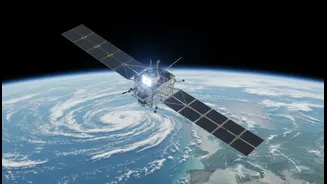
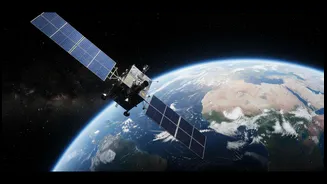
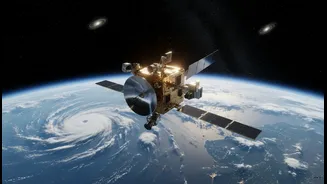
Imagine an orchestra where every instrument is slightly out of tune with the others. The result would be a confusing mess, not a beautiful symphony. This is the challenge climate scientists face today. Dozens of satellites from various countries constantly
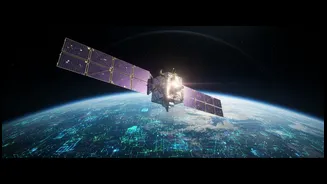
monitor Earth's vital signs, like temperature, ice cover, and atmospheric gases. These satellites are our eyes in the sky, providing critical data for understanding our changing planet. The problem is, each satellite is built differently, with unique sensors that can degrade over time in the harsh environment of space. This leads to small but significant discrepancies in their measurements. One satellite might measure a sea surface temperature that is a fraction of a degree different from another, making it incredibly difficult to combine their data and detect the tiny, long-term trends that signal climate change.
A Tuning Fork in Space
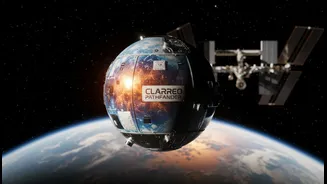
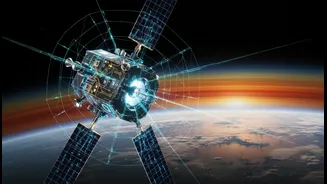
This is where the Climate Absolute Radiance and Refractivity Observatory (CLARREO) Pathfinder comes in. Hosted on the International Space Station (ISS), this NASA instrument is not just another satellite; it's designed to be a definitive reference point, like a tuning fork for the entire satellite orchestra. Its primary job is to measure reflected sunlight from Earth with unprecedented accuracy—five to ten times better than existing sensors. The mission's goal is to demonstrate that it can act as a reliable, on-orbit standard. By taking extremely precise measurements, CLARREO Pathfinder will provide a benchmark that other satellites can be compared against, helping scientists to align and correct their data.
How Inter-calibration Works
The process is called inter-calibration. As the ISS orbits Earth, the CLARREO Pathfinder team can predict when it will pass over the same location as another satellite, such as the CERES or VIIRS instruments. During these events, CLARREO Pathfinder points its advanced spectrometer at the same patch of Earth as the target satellite and they take measurements at nearly the same time. Scientists can then compare the data. Because CLARREO Pathfinder's measurement is highly accurate and traceable to international standards, any differences reveal the biases in the other satellite's sensor. This allows researchers to effectively 're-tune' the data from the vast fleet of existing satellites, making their combined information far more powerful and reliable.
A Sharper Picture of Climate Change
The implications of this new level of accuracy are enormous. With more trustworthy, unified data, scientists can create much more reliable long-term climate records. This will help them detect subtle but critical climate trends with greater confidence and in a shorter amount of time. For example, understanding precisely how much Earth's energy budget is changing—how much heat is being trapped—is fundamental to all climate models. By reducing the uncertainty in satellite measurements, CLARREO Pathfinder will help refine these models, leading to more accurate projections about future warming, sea-level rise, and other impacts. Just this summer, the mission achieved 'first light,' successfully capturing its first detailed science data from space, proving the technology is ready for its groundbreaking work.
Beyond the Mission
The benefits extend beyond just NASA's own instruments. CLARREO Pathfinder's data and methods can be used to improve the value of government and commercial satellite fleets worldwide. The mission will also improve the moon as a calibration standard. By taking highly accurate measurements of the moon's stable, reflective surface, it will help make our lunar neighbor an even more reliable 'standard candle' for calibrating past, present, and future space-based instruments. This 'pathfinder' is a technology demonstration, paving the way for a potential future full-scale CLARREO mission that would provide decades of highly accurate climate observations.