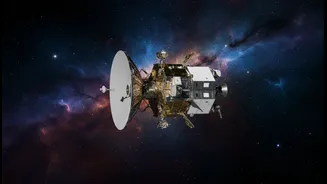









A Pioneer at the Solar System's Edge
Launched in 2006, New Horizons secured its place in history on July 14, 2015, when it became the first spacecraft to perform a close-up study of Pluto. The images and data it sent back transformed our understanding of the dwarf planet, revealing a stunningly
complex world with towering water-ice mountains, vast nitrogen glaciers, and a layered atmosphere. It unveiled a geologically active world where scientists had expected a quiet, frozen ball of rock. But Pluto was just the beginning. The mission was extended, and on January 1, 2019, New Horizons flew past Arrokoth, a Kuiper Belt object, making it the most distant object ever explored up close by a spacecraft. These encounters provided an unprecedented look at the building blocks of our solar system.
The Necessity of Hibernation
Traveling through the Kuiper Belt, a vast and sparsely populated region of icy bodies beyond Neptune, involves immense distances and long cruise periods with no immediate flyby targets. To conserve the spacecraft's limited resources, particularly power from its radioisotope thermoelectric generator, mission controllers at the Johns Hopkins Applied Physics Laboratory (APL) place New Horizons into hibernation. During these periods, most of its systems are powered down, and it enters a stable, spinning mode. However, it's not a complete shutdown. Several key science instruments continue to collect data around the clock, passively monitoring the space environment. This latest slumber, which began on August 7, 2025, was its longest yet, lasting 321 days.
A Wake-Up Call from Billions of Kilometers Away
On June 23, 2026, acting on commands uploaded nearly a year earlier, the probe's onboard computer initiated the wake-up sequence. Due to its staggering distance of about 9.5 billion kilometers (5.9 billion miles) from Earth, the confirmation signal, traveling at the speed of light, took nearly nine hours to reach NASA's Deep Space Network. Mission Operations Manager Alice Bowman confirmed the probe was in good health, stating that weekly status reports throughout the hibernation period were all 'green,' indicating everything was functioning perfectly. This successful recovery is a testament to the remarkable engineering and durability of a spacecraft launched two decades ago, operating in the harsh, cold environment of the outer solar system.
Why This Recovery Is So Important
The celebration in the scientific community stems from what New Horizons can still achieve. Its extended mission is to serve as a unique deep-space observatory. The data it collected even during hibernation provides invaluable information about the solar wind, the stream of charged particles from the Sun, and the dust environment in a region no other active mission is exploring. This helps scientists understand the heliosphere—the protective bubble the Sun creates around our solar system. With more advanced instruments than the legendary Voyager probes, New Horizons will provide higher-fidelity measurements as it travels toward the edge of this bubble and, eventually, into interstellar space. Its observations could even reveal whether the Kuiper Belt is larger than previously thought or if a second belt exists.
The Search for a New Destination
While serving as an observatory is critical, the mission team still hopes to find another Kuiper Belt Object (KBO) for a close flyby. Although a suitable target has not yet been identified, the probe has enough fuel for another potential encounter. The search is ongoing, utilizing powerful ground-based observatories to scan the spacecraft's path for reachable objects. A third flyby would offer another chance to study one of the solar system's most primitive and well-preserved building blocks, offering more clues about how planets form. Each new piece of data, whether from a distant observation or a close encounter, refines our models of planetary formation not just in our own solar system, but around other stars as well.