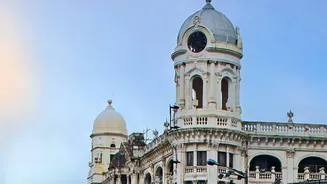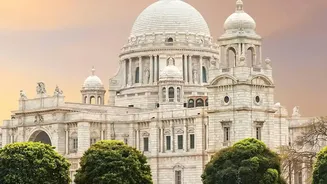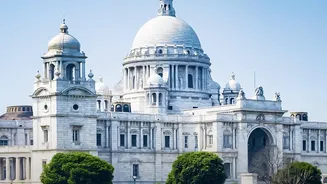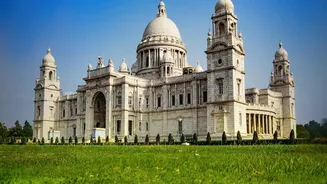


Why is Kolkata often called the 'London of India'? The answer lies not in a museum, but on its streets. We trace the story through a virtual walk, exploring the grand colonial architecture that made Calcutta the British Empire's second city.
The Heart of the Empire: B.B.D. Bagh
Our journey
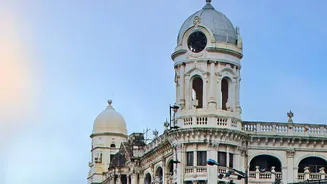
begins at the epicentre of British power, B.B.D. Bagh, formerly known as Dalhousie Square. This area served as the administrative and financial nucleus of British India for over a century. The square is dominated by the monumental Writers' Building, a red-brick behemoth that originally housed the clerks (or 'writers') of the East India Company. Its imposing facade and classical statues were designed to project imperial authority. Nearby, the magnificent General Post Office (GPO) stands on the site of the original Fort William. Its towering dome and Corinthian pillars are textbook examples of the Neoclassical architecture the British used to shape the city in London’s image. Encircling the central Lal Dighi water tank, you'll find a gallery of grand structures like the Royal Insurance Building and the former Treasury Office, each a testament to the area's history as the empire's commercial engine room.
Power and Pageantry on the Esplanade
From the administrative core, we stroll towards the Esplanade, the grand boulevard that was the civic face of British Calcutta. This stretch was designed for promenades and displays of colonial grandeur. Here stands the Calcutta High Court, a stunning example of Gothic Revival architecture, and the elegant Town Hall with its Roman Doric design, which was once the hub of European social gatherings. Further along, the majestic Raj Bhavan, modelled on an English stately home, served as the residence of the Viceroy of India until the capital shifted to Delhi in 1911. This entire district, with its broad avenues and stately buildings, was meticulously planned to mirror the imperial capital, creating a landscape of power that was unmistakably European and solidified the city’s nickname.
The Social Scene: Park Street's Allure
No tour of colonial Calcutta is complete without visiting Park Street, officially Mother Teresa Sarani. While B.B.D. Bagh was for administration, Park Street was for recreation and high society. Once known as Burial Ground Road, it transformed into the epicentre of Kolkata's nightlife. Historic restaurants like Mocambo and iconic tea rooms such as Flurys became institutions where the city's elite socialised. The street was also home to the Asiatic Society, one of India's oldest learned institutions, and the South Park Street Cemetery. Established in 1767, this hauntingly beautiful cemetery is filled with ornate Gothic and Indo-Saracenic tombs, holding the remains of prominent early British residents. This mix of intellectual pursuits, vibrant social life, and solemn memorials shows a different side of the city's London connection—one focused on culture and lifestyle.
More Than Bricks and Mortar
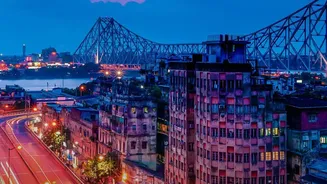
The 'London of India' comparison goes beyond just architecture. It's woven into the very fabric of the city. Kolkata is the only city in India that still operates a tram network, a mode of transport that was once common in London and adds to the city’s old-world charm. The city's location on the Hooghly River also drew parallels with London on the Thames, as both rivers were vital arteries for trade that fuelled imperial growth. The urban planning itself, with its distinct zones—the grand 'White Town' for Europeans and the bustling 'Black Town' for natives—was a colonial import designed to manage and control the capital. Though Kolkata has evolved into a uniquely Indian metropolis, these architectural and cultural remnants are living history, offering a tangible link to its celebrated and complex past.