



The Foundation: Understanding the Banana Leaf
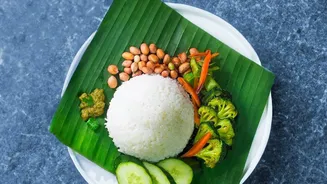
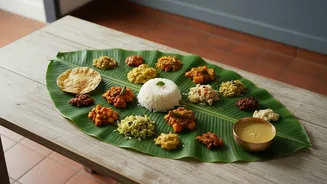
Your plate is a fresh banana leaf, or 'thooshanila', and its placement is intentional. The narrow end of the leaf should always point to your left. This is not just for tradition; the broader right side accommodates the main rice course, making it easier
to eat with your right hand. Before the food arrives, you might be given water to sprinkle on the leaf and wipe it clean—a gesture of respect for the meal to come. All the accompaniments, like pickles and chips, are served on the top half of the leaf.
The Grand Arrival: The Order of Service
A Sadhya is a multi-course vegetarian meal where dishes are served in a specific sequence. It begins on the far left with a pinch of salt, followed by banana chips (upperi), jaggery-coated banana chips (sharkara varatti), and various pickles like mango and lime. Then come the vegetable preparations. You'll see pachadi and kichadi (yoghurt-based dishes), thoran (a dry vegetable stir-fry with coconut), olan (a mild curry of ash gourd in coconut milk), and the star of the show, avial (mixed vegetables in a thick coconut and yoghurt gravy). A crisp pappadam is placed on the left, ready to be crushed over your rice.
The Main Event: Rice and Curries
Once the accompaniments are in place, a mound of fluffy red Matta rice is served on the bottom half of the leaf. The meal begins with the first course: parippu, a simple lentil curry, served with a spoonful of ghee. After you've had some of this, servers will come around with sambar, a flavourful and tangy lentil-based vegetable stew. This is followed by other gravies like pulisseri and rasam, a tangy-peppery soup that aids digestion. The idea is to have several small courses on the same bed of rice.
The Art of Eating: A Hands-On Experience
Sadhya is traditionally eaten with your right hand, without any cutlery. This is believed to enhance the sensory experience, connecting you to your food. Don't be shy. Use your fingertips to mix a small amount of rice with the curries. Create a small well in your rice to hold liquid curries like sambar. The trick is to taste items separately first, then mix them. Crush the pappadam over your rice for a crunchy texture. The general rule is to take small portions of everything, as you can always ask for a second helping. Wasting food is generally frowned upon.
The Sweet Finale: All About Payasam
No Sadhya is complete without payasam, a sweet pudding that serves as dessert. You'll likely be served at least two or three types. Common varieties include Palada Pradhaman (made with rice flakes and milk) and Parippu Pradhaman (made with lentils, jaggery, and coconut milk). Often, a small, ripe banana is served alongside the payasam. You can mash the banana and mix it with the payasam and a piece of pappadam for a truly traditional experience. The payasam is sometimes served directly on the cleaned banana leaf.
Closing the Meal: Folding the Leaf
Once you have finished your meal, including a final glass of 'sambharam' (spiced buttermilk) to aid digestion, there is one last piece of etiquette. You should fold the banana leaf. For a celebratory meal like an Onam Sadhya, you fold the top half of the leaf down, towards you. This signifies that you enjoyed the meal and are satisfied. Folding it away from you is reserved for funeral feasts. It's a small but meaningful gesture that shows your gratitude to the host.