




Whether you're taking a daily stroll or training for a marathon, the way you move matters. Proper form in walking and running is key to preventing injury, boosting efficiency, and simply feeling better. Here’s how to refine your technique.
Start From the Top: Core Posture
Good form begins
with your posture before you even take a step. Think of your body as a stable frame. Stand tall with your head held high, as if being pulled up by a string from the crown of your head. Your eyes should be looking forward, about 10 to 20 feet ahead, not down at your feet. Keep your shoulders pulled back and down, relaxed and away from your ears. This position opens up your chest, which can improve your breathing capacity. It’s also crucial to engage your core by gently drawing your belly button toward your spine. This creates stability and helps maintain the natural 'S' curve of your spine, which is vital for absorbing impact.
The Rhythm of Your Stride
Stride mechanics differ between walking and running, but some principles apply to both. The main goal is to have your foot land underneath your body's center of mass, not far out in front. Landing your foot too far ahead, known as overstriding, creates a braking force that wastes energy and puts excess stress on your knees and lower back. To avoid this, focus on increasing your cadence, or the number of steps you take per minute. A quicker, lighter stride is generally more efficient. For runners, a cadence of around 170-180 steps per minute is often recommended as a target to naturally shorten stride length and reduce impact forces.
How to Walk with Purpose
Proper walking involves a rolling motion with your feet. Your heel should strike the ground first, followed by a smooth roll through the arch to the ball of your foot, and finally a push-off from your toes. This heel-to-toe pattern helps absorb shock and uses the muscles in your feet and calves effectively. Your arms should swing naturally from the shoulder, not the elbow, with a slight bend. They should move forward and backward, not across your body, as side-to-side swinging can waste energy and throw off your balance. Keep your hands relaxed, not clenched into a tight fist.
How to Run More Efficiently
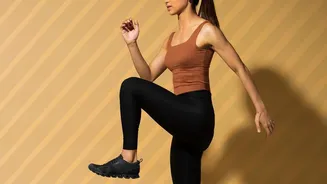
While walking always keeps one foot on the ground, running includes a 'flight' phase where both feet are airborne. To run efficiently, maintain that tall, upright posture with a slight forward lean that comes from your ankles, not your waist. This helps use gravity to your advantage. As with walking, your arms are important for rhythm and balance; keep them bent at roughly a 90ndegree angle and drive them back from the shoulder. When it comes to foot strike, there's much debate between heel-striking and forefootstrikng. However, most experts agree that the more important factor is ensuring your foot lands under your center of gravity, regardless of which part of the foot hits first.
Common Form Mistakes to Correct
Many people develop poor habits without realizing it. One of the most common is slouching, which compresses your lungs and restricts oxygen flow. Looking down at your feet is another frequent error that pulls your entire upper body out of alignment. Be mindful not to hunch your shoulders up toward your ears or swing your arms across the center line of your body. Also, avoid the temptation to 'overcorrect' by being too rigid or pulling your shoulders too far back, as this can create other imbalances. The goal is a posture that is upright but relaxed, allowing for smooth, fluid movement.