







What Happened on Flight AI 2030?
On Wednesday, October 14, Air India flight AI 2030, a Boeing 787-9 carrying 293 passengers and 13 crew members, was en route to Delhi from Frankfurt. As the aircraft entered Indian airspace, a hijack alert was apparently detected by Air Traffic Control
(ATC) in Mumbai. Following established security protocols for such a serious warning, the flight was immediately diverted to Jaipur International Airport. The aircraft landed safely and was moved to an isolation bay, where security agencies conducted thorough checks. Passengers were deboarded for screening before being cleared to reboard for the remainder of their journey to Delhi. Air India confirmed the diversion was due to a 'perceived security concern' and stated that the safety of passengers and crew remains its highest priority.
A 'Ghost' in the Machine?
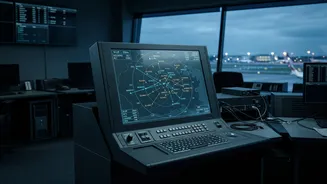
In the initial hours, speculation pointed towards an accidental activation of the '7500' transponder code by the pilots, the universal signal for unlawful interference or hijacking. However, subsequent reports and sources close to the investigation suggest this may not be the case. The flight crew reportedly communicated to controllers that all operations on board were normal, and senior pilots have noted that activating the code is a deliberate, multi-step process, making an accidental trigger highly unlikely. Instead, the focus of the probe, led by the Directorate General of Civil Aviation (DGCA), has shifted towards a potential technical glitch on the ground. Investigators are now closely examining a newly installed radar system at the Mumbai ATC to determine if it generated a false alert.
How Ground Radar Works
Air Traffic Control relies on radar to 'see' aircraft in the sky. Primary radar works by sending out radio waves that bounce off aircraft, returning a 'blip' on the controller's screen that shows the plane's position. Secondary Surveillance Radar (SSR) is more advanced. It sends an interrogation signal to an aircraft's transponder, which then replies with a wealth of data, including its identity, altitude, and speed. This system is the backbone of modern air traffic management. A false alert, sometimes called a 'phantom' or 'ghost' blip, can occur for several reasons, including atmospheric conditions, signal reflections from ground objects, or software and hardware malfunctions within the radar system itself. Such anomalies can create a false target or, as is being investigated in this case, potentially misinterpret a valid signal as a distress code.
The Investigation's Next Steps
The DGCA's investigation will be a meticulous process. Officials will analyze the data logs from the Mumbai ATC's radar and communication records between the controllers and the flight crew. The aircraft's flight data recorder (FDR) and cockpit voice recorder (CVR), commonly known as the 'black boxes', will also be examined to build a complete picture of the event from both the ground and air perspectives. The probe aims to definitively establish what triggered the security response. Civil Aviation Minister K Rammohan Naidu has stated that any potential changes to security norms will only be considered after the investigation is complete and the precise cause is understood.
Safety Systems and False Alarms
While unsettling, the incident also highlights that aviation safety protocols are designed to be cautious. The diversion was executed based on a perceived threat, and all security measures were followed to the letter, ensuring no harm came to anyone on board. False alarms, while rare, are not entirely unknown in global aviation. They can be triggered by a variety of factors, from internal equipment malfunctions on an aircraft to external interference. Each incident provides valuable data for engineers and regulators to further refine the complex, layered systems that keep air travel safe. The alert over Indian skies, though ultimately false, prompted exactly the kind of cautious and coordinated response it was designed to.