



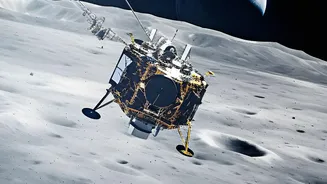
An Eight-Year Interplanetary Journey
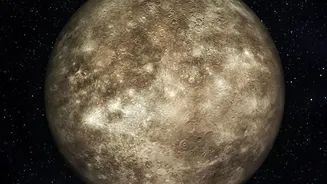
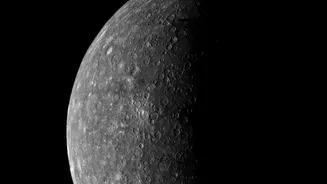
Launched in October 2018, BepiColombo is a joint mission between the European Space Agency (ESA) and the Japan Aerospace Exploration Agency (JAXA). Its destination is Mercury, the least explored rocky planet in our solar system. Getting to Mercury is incredibly
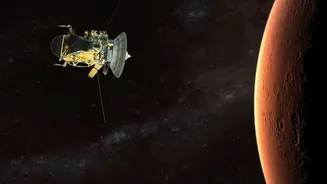
difficult; the Sun's immense gravity constantly accelerates any approaching spacecraft. To counteract this, BepiColombo executed a complex series of nine gravity-assist flybys—one of Earth, two of Venus, and six of Mercury itself—to gradually slow down and align its trajectory for orbital insertion. For this entire cruise phase, the mission's two science orbiters, ESA’s Mercury Planetary Orbiter (MPO) and JAXA’s Mercury Magnetospheric Orbiter (Mio), have been travelling together as a single stacked spacecraft.
The Cosmic Tugboat's Job Is Done
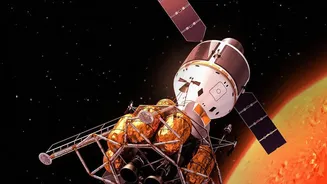
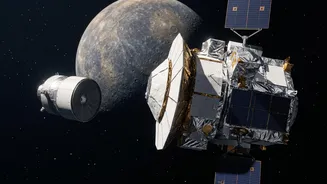
The secret to this long and fuel-efficient journey was the Mercury Transfer Module (MTM). Think of the MTM as the mission’s powerful cosmic tugboat. Equipped with an advanced solar-electric propulsion system, its four ion thrusters provided the gentle, continuous thrust needed to navigate the inner solar system for nearly eight years. The MTM's job was purely to transport the two science orbiters, MPO and Mio, from Earth to Mercury. Having successfully delivered its precious cargo across billions of kilometres, the transfer module has now fulfilled its primary function. Its ion engines were permanently shut down in June 2026, paving the way for the mission's next chapter.
Why Separation Is Happening Now
The separation of the Mercury Transfer Module, which occurred on September 3, 2026, marks the official start of the 'arrival phase' at Mercury. This event is happening now because the MTM is no longer needed. In fact, keeping it would be a liability. The MTM's role was cruise control, not orbital science. To enter a stable orbit around Mercury, the spacecraft needs to be as light as possible. Jettisoning the massive transfer module significantly reduces the mass, allowing the MPO's onboard chemical thrusters to perform the final, crucial maneuvers for orbital insertion. With the MTM gone, the remaining spacecraft stack is now in a free-fall trajectory toward the planet, ready for its capture by Mercury's gravity in November 2026.
A New Beginning for Two Orbiters
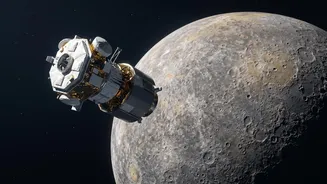
Casting off the transfer module is not an ending, but the beginning of the core scientific mission. Now free from its transport vehicle, the combined MPO and Mio spacecraft will enter orbit together in November 2026. The next major step will occur in December 2026, when the two orbiters will separate from each other. Each will then proceed to its own unique orbit, optimized for its specific scientific goals. ESA's MPO will enter a low, circular orbit to map the planet's surface and analyse its composition. JAXA's Mio will enter a more elliptical orbit to study Mercury's magnetic field and its interaction with the solar wind. This dual-orbiter approach will provide an unprecedented, three-dimensional view of the mysterious planet.
What We Hope to Learn
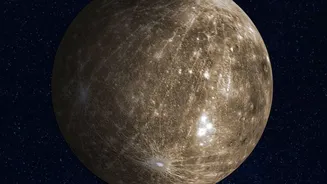
With science operations set to begin in April 2027, BepiColombo aims to solve some of Mercury's most enduring mysteries. Scientists want to understand why Mercury has such a large iron core, the origin of its magnetic field, and whether its polar craters truly contain water ice. The mission's instruments will map the surface in incredible detail, analyse the composition of its thin atmosphere (or exosphere), and study the harsh plasma and particle environment surrounding the planet. By studying the planet closest to our star, researchers hope to gain crucial insights into how the inner planets of our solar system formed and evolved.