
The Beginning of the End
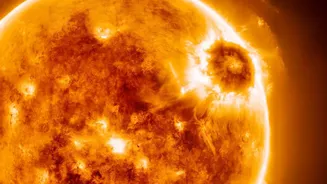
Like all stars of its size, our Sun is currently in its 'main sequence' phase, fusing hydrogen into helium in its core. This process creates an outward pressure that perfectly balances the inward crush of gravity. But when the hydrogen fuel in its core runs
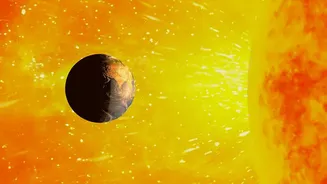
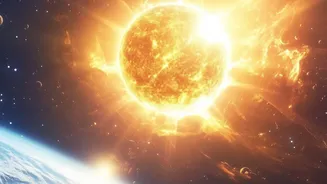
out in roughly five billion years, gravity will take over. The core will contract and heat up, causing the Sun's outer layers to expand dramatically. The Sun will swell into a red giant, becoming so large it will likely engulf Mercury, Venus, and possibly even Earth. This phase marks the beginning of the end, setting the stage for the star to lose a significant portion of its mass.
What Is Stellar Mass Loss?
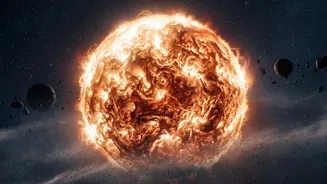
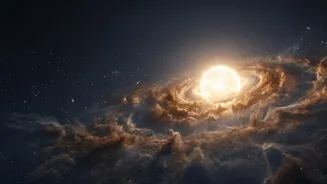
As a star enters its final phases, it begins to shed its outer layers of gas and dust into space. This process is known as stellar mass loss. For a star like our Sun, it can lose up to half of its total mass this way. This isn't just a minor detail; it is the fundamental process that transforms a bloated red giant into its final, compact state: a white dwarf. The ejected material forms a beautiful, glowing structure called a planetary nebula, which enriches the galaxy with heavier elements like carbon and oxygen created inside the star. Scientists have identified two main ways this mass loss can happen: smoothly or in dramatic bursts.
The Smooth Approach: A Steady Wind
One method of mass loss is a powerful and continuous stellar wind. Think of it as an extremely amplified version of the solar wind our Sun produces today. As the star becomes a red giant, these winds become much stronger and denser, steadily carrying away the star's outer atmosphere over millions of years. This process is relatively gradual, like a slow and steady release of pressure. The material flows outward, gradually thinning the star's enormous envelope until the hot, dense core is all that remains. This steady wind is a key factor in the evolution of many dying stars, contributing to the slow, drawn-out process of forming a planetary nebula.
The Bursty Alternative: Violent Pulses
The other method is far more dramatic. In the late stages of a star's life, the shells of helium and hydrogen burning inside it can become unstable. This can lead to periodic, violent events called 'thermal pulses'. During a thermal pulse, a shell of helium suddenly ignites in a runaway fusion reaction, releasing a tremendous burst of energy. This pulse violently pushes the star's outer layers into space. These bursts are episodic, occurring every few thousand to tens of thousands of years, with each event ejecting a substantial chunk of mass. A recent study exploring burst-driven scenarios suggests this 'piece by piece' departure drastically changes how the surrounding planets' orbits evolve.
Our Sun’s Predicted Farewell
So, which path will our Sun take? Most astronomers believe it will likely be a combination of both. The Sun will experience strong, steady stellar winds, but it will also undergo a series of thermal pulses in its final Asymptotic Giant Branch (AGB) phase. These pulses will become increasingly intense, driving powerful, episodic mass loss. This 'pulsing' is what will ultimately expel the Sun's outer layers to form a spectacular planetary nebula, leaving behind a white dwarf about the size of Earth. Studying other dying stars and their surrounding nebulae gives us a preview of this process, showing intricate shells and structures that are likely the result of these repeated bursts.
A Changed Solar System
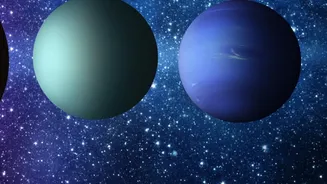
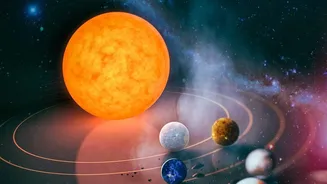
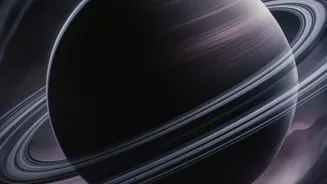
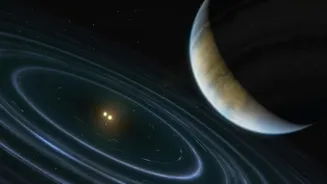
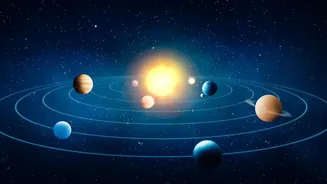
The Sun's mass loss will have profound consequences for the remaining planets. As the Sun's mass decreases, its gravitational grip will weaken. This will cause the orbits of the outer planets—Jupiter, Saturn, Uranus, and Neptune—to expand, settling into new, more distant paths. While the inner planets face incineration, the outer solar system will be transformed. For a time, the habitable zone, the region where liquid water could exist, will shift outward. Moons like Saturn's Titan or the distant dwarf planets in the Kuiper Belt could experience Earth-like temperatures for hundreds of millions of years, potentially offering a 'second wind' for life in our solar system.